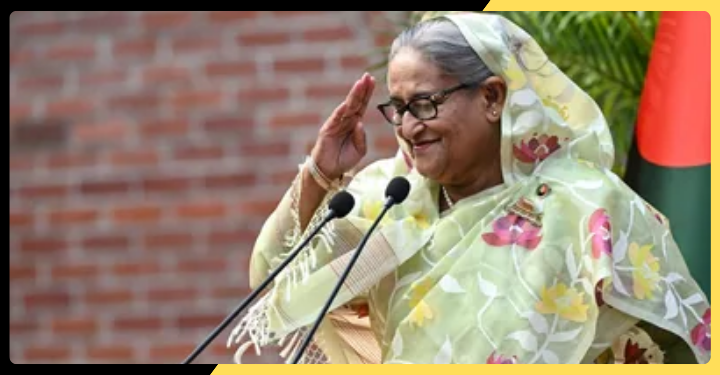
The reported plan of former Bangladesh Prime Minister Sheikh Hasina to deliver a speech from New Delhi has emerged as a significant diplomatic issue between India and Bangladesh, prompting Dhaka to seek an official clarification from the Indian government. The development has attracted attention across South Asia, with analysts describing it as a sensitive test of diplomacy between two countries that have built one of the region’s closest bilateral partnerships over the past decade.
Thank you for reading this post, don't forget to subscribe!According to media reports and diplomatic sources, Bangladesh’s interim administration has formally communicated with New Delhi to understand India’s position on the proposed speech. The concern reportedly stems from the possibility that a political address delivered from Indian territory could influence Bangladesh’s domestic political landscape during a period of political transition.
While the Indian government has not publicly commented on the reported request, officials are believed to be handling the matter through diplomatic channels. Similarly, Bangladesh has not issued a detailed public statement regarding the communication, preferring to allow discussions to continue between the two governments.
The issue gained prominence after reports suggested that Sheikh Hasina, who has been staying in India since leaving Bangladesh amid political unrest, was considering a public address to her supporters and members of the Bangladeshi diaspora. Although details regarding the date, venue, and format of the speech remain unconfirmed, the reports have generated widespread political and diplomatic interest.
India has consistently maintained that Sheikh Hasina’s stay in the country is based on humanitarian grounds. Since her arrival, New Delhi has avoided making public comments on her political activities, emphasizing instead its commitment to maintaining strong and stable relations with Bangladesh regardless of domestic political developments.
For Bangladesh, however, the proposed speech carries broader political implications. Officials reportedly believe that any political message delivered by the former prime minister from another country could influence public opinion within Bangladesh or be interpreted as external involvement in domestic affairs. As a result, Dhaka has sought clarification before the event takes place rather than reacting afterward.
Diplomatic experts note that such requests are common in international relations and should not automatically be viewed as signs of deteriorating ties. Governments frequently exchange diplomatic communications to address concerns before they become larger disputes. In this case, Bangladesh’s request reflects an effort to ensure transparency and preserve mutual trust.
India now faces the challenge of balancing humanitarian considerations with diplomatic responsibilities. As a neighboring country with close historical, cultural, and economic ties to Bangladesh, New Delhi has consistently emphasized respect for the sovereignty and internal affairs of friendly nations. This principle has guided India’s foreign policy in previous situations involving political leaders from neighboring countries.
Foreign policy analysts believe India is likely to adopt a cautious approach, carefully evaluating the diplomatic consequences of any decision regarding the proposed speech. Whether the event is permitted, modified, postponed, or conducted in a private format remains uncertain until official announcements are made.
The importance of the issue is amplified by Sheikh Hasina’s political stature. Having served as Bangladesh’s prime minister for multiple terms, she remains one of the country’s most influential political personalities. Her statements continue to attract considerable attention among supporters, political opponents, international observers, and the Bangladeshi diaspora.
Despite the current diplomatic sensitivity, the broader relationship between India and Bangladesh remains strong. Over the years, the two countries have developed extensive cooperation across trade, energy, infrastructure, transportation, border security, defense, education, health, and cultural exchanges.
Bilateral trade has expanded steadily, making Bangladesh one of India’s most important trading partners in South Asia. Infrastructure initiatives, including railway modernization, road connectivity, inland water transport, and electricity-sharing projects, have significantly strengthened economic integration between the two countries.
Security cooperation has also become a major pillar of the partnership. India and Bangladesh have worked together to combat terrorism, cross-border crime, illegal trafficking, and other regional security challenges. These joint efforts have contributed to improved border management and enhanced regional stability.
Regional analysts argue that neither government is likely to allow the current issue to overshadow decades of successful cooperation. Both countries have substantial strategic interests in maintaining stable diplomatic relations, particularly at a time when South Asia faces evolving geopolitical and economic challenges.
International observers are closely monitoring the developments because India and Bangladesh play important roles in promoting regional connectivity through initiatives involving road networks, ports, railways, and maritime cooperation in the Bay of Bengal. Continued collaboration between the two countries is widely regarded as essential for regional economic growth and security.
The ultimate impact of Sheikh Hasina’s proposed speech may depend largely on its content. If the address focuses on personal reflections, appeals for peace, or communication with supporters abroad, it may attract less diplomatic concern. However, if it includes direct political criticism, commentary on Bangladesh’s interim administration, or calls for political mobilization, the reaction from Dhaka could be considerably stronger.
At present, there is no official confirmation regarding whether the speech will take place or whether Indian authorities have granted permission for such an event. Diplomatic consultations are expected to continue as both governments seek to manage the issue without allowing it to affect their broader strategic partnership.
For India and Bangladesh, the situation serves as a reminder that even close bilateral relationships require careful diplomacy when politically sensitive issues arise. Both governments are expected to continue prioritizing dialogue, mutual respect, and regional stability while working toward a solution that protects their long-term partnership and prevents unnecessary diplomatic tensions.