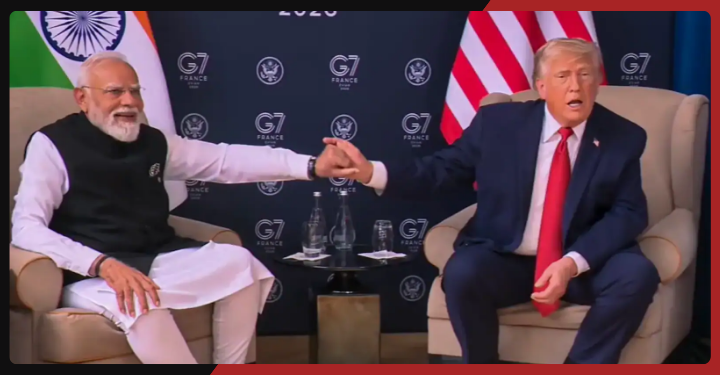
The debate over voter identification in the United States has taken a new turn after President Donald Trump invoked India’s electoral system as evidence supporting mandatory photo ID requirements.
Thank you for reading this post, don't forget to subscribe!Trump’s remarks have attracted attention in both countries because they connect two very different electoral systems through a single issue: voter identification.
The president recently said that India’s Chief Election Commissioner Gyanesh Kumar had questioned how American elections could be conducted without mandatory photo identification. Trump used the reported observation to renew his demand for passage of the SAVE America Act.
The proposed law is one of Trump’s major election-policy priorities.
Under the legislation, people registering to vote in federal elections would be required to provide documentary proof of US citizenship. The broader proposal also seeks stronger voter-identification requirements and changes to aspects of voting procedures.
Trump argues that the law would protect American elections from fraud and ensure that only eligible citizens participate.
The White House has made a similar argument, saying that voter ID should be a basic election safeguard. Its official presentation of the SAVE America Act explicitly references India’s voter-identification framework.
Trump has also focused on the size of India’s electorate.
He cited around 646 million voters in India’s recent general election and highlighted the fact that less than one per cent of voters used postal ballots, according to his figures. He presented the numbers as proof that a large democracy can operate with strong identification requirements.
But America’s voting system has a different history.
The United States does not have one single national election-administration structure comparable to India’s Election Commission. States and local authorities play major roles in organising elections.
As a result, voter-ID rules vary across the country.
Some states have strict photo-ID requirements, while others allow alternative documents or other verification methods. This patchwork system has long been a source of political debate.
Trump wants to move toward a more consistent national standard.
Supporters say national requirements would strengthen confidence in elections. They argue that showing identification is a simple and reasonable step that can help verify voters.
Opponents worry about access.
They argue that some eligible Americans may not have the documents required under stricter rules and could face additional costs or administrative barriers. The debate therefore revolves around how to balance election security with voting accessibility.
The issue becomes even more significant because of the approaching 2026 midterm elections.
Election rules could have major political consequences, especially in closely contested states. Any federal legislation changing registration or identification requirements would therefore face intense scrutiny.
Trump’s India comparison also has an international political dimension.
India is frequently recognised for administering elections on an enormous scale. The fact that Trump has chosen India as an example indicates that the country’s electoral machinery is being viewed as a potential reference point in American political discussions.
At the same time, experts and observers need to be cautious about treating the two systems as interchangeable. Differences in constitutional structure, election administration, voter registration and voting methods mean that policies that operate in India may require significant adaptation in the United States.
Trump’s comments have nevertheless succeeded in bringing India directly into the American voter-ID conversation.
The White House continues to promote the SAVE America Act, while political opponents remain concerned about its potential effects on voting access. Meanwhile, US Ambassador Sergio Gor has publicly supported Trump’s comparison with India.
The latest controversy therefore extends beyond the question of whether voters should carry identification.
It raises larger questions about how democracies protect elections, how citizens establish eligibility and how governments balance election security with access to the ballot box.
As the US heads toward its midterm elections, Trump’s reference to India is likely to remain an important part of the political conversation surrounding the future of American voting rules.