
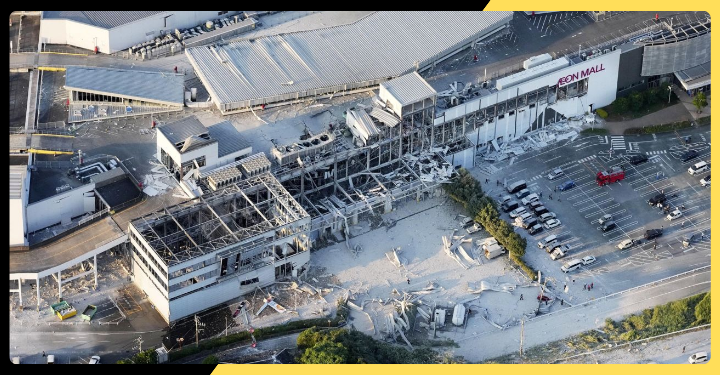
Japan declared a state of emergency in the aftermath of a devastating magnitude 7.1 earthquake that triggered a deadly explosion at a crowded shopping mall, leaving several people dead, dozens injured, and many others missing. The disaster unfolded in two terrifying stages, beginning with a powerful earthquake that shook buildings across the region and ending with a massive blast that caused a partial collapse of the shopping complex. Authorities immediately launched one of the country’s largest emergency response operations, deploying rescue teams, firefighters, medical personnel, and military units to save lives and restore order.
Thank you for reading this post, don't forget to subscribe!The earthquake struck during peak shopping hours when hundreds of people were inside the mall. Residents described the violent shaking as one of the strongest they had experienced in recent years. Buildings swayed, ceiling panels fell, shop shelves collapsed, and power briefly failed in several neighbourhoods. Emergency warning systems alerted citizens to take cover or move to open areas as the tremors spread across the affected prefecture.
Although Japan’s strict building codes helped prevent widespread structural failures, the earthquake caused significant damage to underground infrastructure, roads, and utility networks. Public transport services, including high-speed trains and metro systems, automatically suspended operations while engineers began inspecting tracks and bridges for safety.
Only minutes after the earthquake ended, a powerful explosion ripped through a multi-storey shopping mall that had already been weakened by the tremors. Witnesses reported hearing a thunderous blast that could be heard several kilometres away. Thick black smoke rose above the city skyline as flames engulfed sections of the building. Windows shattered across nearby streets, vehicles were damaged by flying debris, and frightened shoppers ran in every direction seeking safety.
The explosion caused parts of the mall’s roof and upper floors to collapse, trapping shoppers, employees, and maintenance workers beneath heavy concrete slabs and twisted steel beams. Inside the building, visibility quickly disappeared as smoke, dust, and debris filled the corridors. Survivors later described hearing cries for help from people trapped beneath collapsed walls while others desperately searched for missing relatives.
Emergency responders reached the scene within minutes despite damaged roads and heavy traffic. Firefighters immediately began battling fires that had spread throughout several retail stores and food outlets. At the same time, specialised urban search-and-rescue teams entered the unstable building using thermal imaging cameras, drones, listening devices, and trained rescue dogs to locate survivors.
The rescue operation was extremely dangerous because aftershocks continued to shake the damaged structure. Engineers constantly monitored the stability of the building while rescue workers carefully removed debris using hydraulic cutting tools, cranes, and heavy lifting equipment. Every movement had to be planned to avoid triggering further collapses that could endanger both victims and emergency personnel.
Hospitals across the region activated emergency disaster protocols to manage the growing number of casualties. Ambulances transported victims suffering from burns, broken bones, head injuries, smoke inhalation, and severe cuts caused by shattered glass. Doctors, nurses, surgeons, and emergency medical staff worked continuously throughout the day and night to treat patients, while blood banks appealed to the public for urgent donations.
Government officials confirmed multiple fatalities and warned that the death toll could rise as rescue teams gained access to previously unreachable sections of the collapsed shopping centre. Several people remained missing, prompting authorities to continue round-the-clock search operations despite difficult conditions.
Investigators launched an immediate inquiry into the cause of the explosion. Early evidence suggested that underground gas pipelines may have ruptured during the earthquake, allowing gas to accumulate before igniting. Other investigators examined the possibility of damaged electrical systems causing sparks that triggered the blast. Officials stressed that a full forensic investigation would determine the exact sequence of events.
The Japanese government activated its highest level of disaster response, coordinating efforts between local authorities, police departments, fire services, emergency medical agencies, and the Japan Self-Defense Forces. Additional rescue personnel and specialised equipment were transported from neighbouring regions to strengthen ongoing operations. Temporary command centres were established near the disaster zone to coordinate emergency efforts efficiently.
Beyond the shopping mall, the earthquake caused widespread disruption across the region. Thousands of homes experienced power outages, while gas and water services were suspended in damaged districts as a precaution. Telecommunications networks became overloaded as anxious residents attempted to contact family members, although emergency communication systems remained operational.
Schools, community centres, and sports halls were converted into temporary evacuation shelters for residents unable to return home. Volunteers distributed meals, bottled water, blankets, hygiene supplies, baby formula, and emergency medicines. Mental health professionals also provided counselling to survivors struggling with the emotional impact of the disaster.
Seismologists warned that strong aftershocks could continue for days, urging residents to remain vigilant and avoid entering damaged buildings until safety inspections were completed. Authorities encouraged every household to keep emergency kits containing food, drinking water, flashlights, batteries, first-aid supplies, portable radios, and essential medications.
As rescue teams continued their painstaking search beneath floodlights through the night, families gathered outside hospitals and emergency shelters hoping for positive news. Every successful rescue brought moments of relief amid overwhelming grief, while every passing hour reminded the nation of the fragile balance between preparedness and nature’s immense power.
The twin tragedy has once again highlighted Japan’s resilience in the face of natural disasters. While the country possesses some of the world’s most advanced earthquake-resistant infrastructure and emergency response systems, this devastating event demonstrates that secondary disasters such as explosions and fires can dramatically increase the human toll. As recovery begins, Japan’s focus remains on saving lives, supporting affected families, rebuilding damaged communities, and strengthening disaster preparedness for the future.