
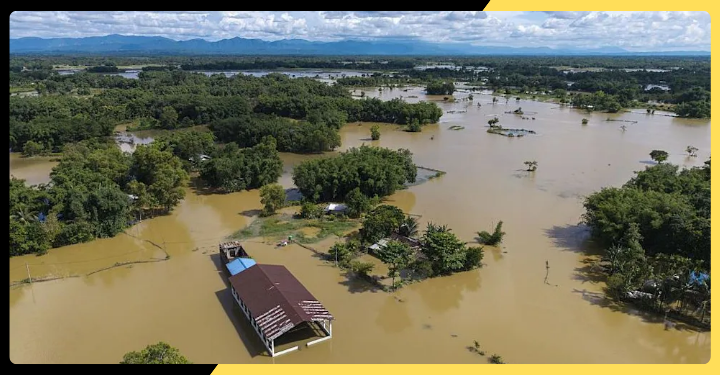
After weeks of relentless monsoon rains and overflowing rivers, Assam is slowly emerging from one of its worst flood disasters in recent years. While water levels have begun to recede in several districts, the real challenge is only beginning. Thousands of families who survived the floods now face the daunting task of rebuilding their homes, restoring their livelihoods, and recovering from a disaster that changed their lives forever.
Thank you for reading this post, don't forget to subscribe!The floods swept through villages and towns with tremendous force, submerging homes, schools, hospitals, roads, bridges, and farmland. Entire communities were forced to evacuate, leaving behind years of hard-earned possessions. Many families escaped with only the clothes they were wearing, while others lost livestock, crops, and valuable documents in the rising waters.
Relief camps became temporary homes for thousands of displaced residents. Government agencies, disaster response teams, non-governmental organisations, and volunteers worked together to provide food, drinking water, medicines, clothing, and shelter. Their swift response saved countless lives, but for many survivors, returning home marks the beginning of another difficult journey.
As floodwaters recede, the full extent of the destruction is becoming clear. Homes built from bamboo, wood, and mud have collapsed, while stronger concrete structures have suffered severe structural damage. Roads have been washed away, bridges damaged, and electricity and communication services disrupted in many remote areas.
For rural families, restoring agriculture is one of the biggest priorities. Assam’s economy depends heavily on farming, with rice, vegetables, tea, mustard, and other crops providing income for millions of people. Floodwaters destroyed standing crops across vast areas, leaving farmers without harvests or savings. Many now depend on government compensation, financial assistance, and community support to prepare for the next planting season.
Livestock losses have also been significant. Cattle, goats, poultry, and other animals are valuable assets for farming families, providing milk, income, and labour. Replacing these animals will require considerable investment, making financial recovery even more challenging.
Education has also suffered a major setback. Many schools remain damaged or have been used as relief camps during the emergency. Thousands of students lost textbooks, uniforms, and school supplies. Authorities are now working to repair educational institutions so children can return to classrooms as quickly as possible.
Healthcare remains another important concern during the recovery phase. Floodwaters often leave behind contaminated water sources, increasing the risk of diseases such as diarrhoea, cholera, typhoid, and hepatitis. Mosquito breeding in stagnant water also raises concerns about malaria and dengue. Medical teams continue organising health camps while distributing medicines and promoting hygiene awareness.
The emotional impact of the disaster cannot be overlooked. Many survivors continue to cope with the trauma of losing homes, loved ones, and livelihoods. Children who witnessed dangerous rescue operations and families who lost everything face long-term psychological challenges. Mental health support is becoming an increasingly important part of disaster recovery programmes.
Environmental recovery is equally important. Riverbank erosion has destroyed agricultural land and displaced communities permanently in some areas. Wetlands, forests, and wildlife habitats have been affected by prolonged flooding. Conservation experts emphasise the importance of restoring damaged ecosystems, as healthy forests and wetlands help reduce future flood risks by naturally absorbing excess water.
Climate experts believe that Assam’s floods are becoming more severe due to changing weather patterns associated with global climate change. Increased rainfall intensity, deforestation, rapid urbanisation, and sediment accumulation in rivers have all contributed to worsening flood conditions. These factors highlight the need for long-term planning rather than temporary solutions.
Government authorities have announced rehabilitation programmes that include financial compensation for affected families, repair of damaged infrastructure, housing assistance, crop-loss compensation, and support for small businesses. Reconstruction efforts are expected to continue for several months as engineers rebuild roads, bridges, schools, healthcare centres, and public utilities.
Community participation has become one of the strongest pillars of recovery. Volunteers continue cleaning villages, repairing homes, distributing relief materials, and helping elderly residents return safely. Youth groups, local organisations, and charitable institutions have organised donation drives and community kitchens, demonstrating remarkable solidarity during the crisis.
Experts stress that Assam must strengthen its disaster preparedness for the future. Better flood forecasting systems, improved embankments, climate-resilient housing, stronger drainage infrastructure, wetland conservation, and sustainable land-use planning can significantly reduce the impact of future floods. Public awareness campaigns and regular disaster preparedness drills can also help communities respond more effectively when emergencies occur.
The recent floods have once again reminded the nation of Assam’s resilience. Despite suffering enormous losses, communities have shown extraordinary courage, compassion, and determination. Neighbours have helped neighbours, rescue workers have risked their lives to save strangers, and volunteers have worked tirelessly to support those in need.
Recovery will not happen overnight. Rebuilding homes, restoring livelihoods, repairing infrastructure, and healing emotional wounds will take months and, in some cases, years. Yet history has shown that the people of Assam possess remarkable strength in the face of adversity.
From surviving one of the state’s worst floods in years to rebuilding stronger communities, Assam’s journey is far from over. With continued government support, effective disaster management, environmental conservation, and community unity, the state can transform this tragedy into an opportunity to build a safer and more resilient future.