
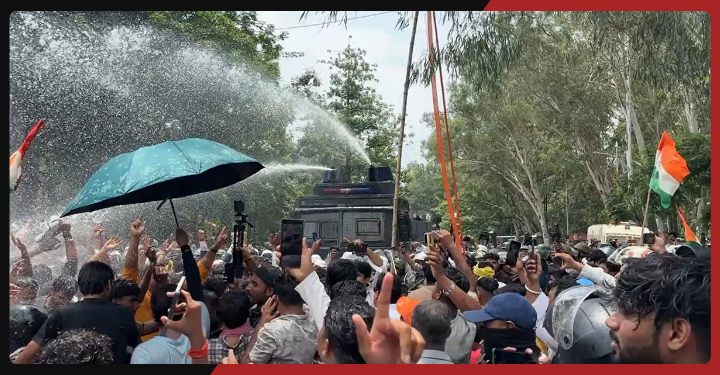
RANCHI: Jharkhand witnessed a major escalation in the ongoing student movement on Monday as thousands of job aspirants marched towards the state Assembly over alleged irregularities in recruitment examinations. The protest, which began as a campaign for transparency and accountability, turned tense after demonstrators breached police barricades.
Thank you for reading this post, don't forget to subscribe!Security forces responded with water cannons and lathi-charge, while reports also said tear gas was used to disperse protesters. The confrontation occurred as students attempted to advance towards the Assembly despite heavy security arrangements.
The Assembly march was planned after the failure of negotiations between student representatives and the state government. Protesters have maintained that their core demand—a CBI investigation into alleged irregularities in recruitment examinations—has not been accepted.
The controversy involves recruitment examinations conducted by JPSC and JSSC. Students have raised allegations concerning examination procedures, results and the overall functioning of recruitment institutions. They argue that an independent investigation is necessary to establish the facts and identify responsibility.
The 14th JPSC Civil Services Examination has become a major focus of the agitation. Student organisations have demanded cancellation of the examination and called for an investigation into alleged irregularities. Earlier demonstrations in Ranchi attracted thousands of aspirants.
The government has responded that it has accepted or addressed most of the students’ demands. However, protesters have rejected the government’s assessment, saying that several important demands remain pending. Reports have highlighted the dispute over the government’s claim that 98% of demands have been fulfilled.
The gap between the two sides has prevented a settlement.
For the government, the issue is also about maintaining control around a sensitive constitutional institution. The Assembly is a high-security location, and authorities had imposed prohibitory restrictions and increased police deployment ahead of the march.
For the students, reaching the Assembly was a way of directly highlighting their demands to the political leadership.
The march eventually produced scenes of confrontation. As protesters encountered barricades, some attempted to push forward. Police responded with crowd-control measures, including water cannons and lathi-charge. Tear gas was also reported.
The latest development could have consequences beyond Ranchi. Recruitment examination controversies have become politically sensitive because they directly affect young people seeking government employment.
The issue has already drawn opposition criticism. BJP leaders have demanded a CBI investigation and accused the government of failing to adequately address the concerns of aspirants. BJP MPs staged a separate protest in Parliament over alleged recruitment irregularities in Jharkhand.
The state government has maintained that it is willing to discuss the matter. Chief Minister Hemant Soren has emphasized dialogue and said that students’ concerns should be addressed through justice and transparency rather than force.
However, the latest confrontation indicates that the dialogue process has not yet restored trust.
The student movement has also highlighted the pressure faced by young job seekers in Jharkhand. Competitive government examinations can attract huge numbers of candidates for relatively limited vacancies. Candidates often spend years preparing, making the credibility of every examination extremely important.
If allegations of malpractice arise, students may demand cancellation, re-examination or independent investigation. Such decisions can affect thousands of candidates and create additional delays.
The government therefore faces the challenge of addressing genuine concerns without disrupting the entire recruitment system.
A credible resolution could require several elements: a transparent investigation into disputed allegations, publication of relevant findings, clear examination schedules and reforms aimed at preventing future irregularities. Whether such measures are sufficient to satisfy protesters will depend on the details and credibility of the process.
Monday’s Assembly march has demonstrated that the students are not ready to end the agitation simply on the basis of government assurances. Their continued mobilisation shows the depth of distrust surrounding the recruitment process.
At the same time, the use of police force has introduced a new layer of tension. Future developments will depend on whether both sides choose escalation or return to negotiations.
For Jharkhand, the issue is bigger than one protest or one examination. It concerns the credibility of the state’s recruitment system and the confidence of an entire generation of job aspirants.
The immediate demand from the students is for accountability and an independent investigation. The government’s challenge is to provide a response that is both legally credible and acceptable to those who believe their future has been affected.
Until that confidence is restored, the student agitation is unlikely to disappear. Monday’s confrontation near the Assembly has made clear that the recruitment controversy remains unresolved and that the pressure on the Jharkhand government is continuing to grow.


