
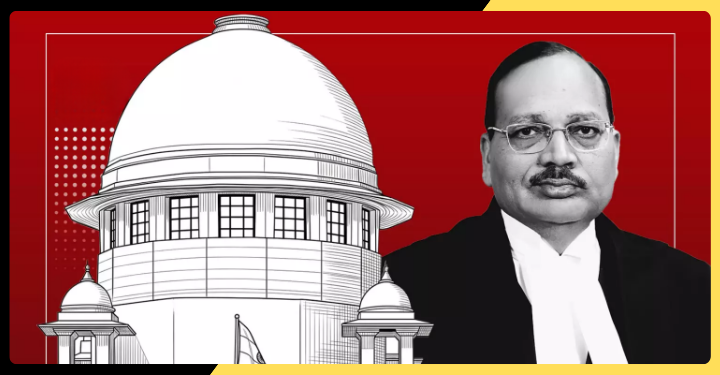
The Supreme Court has sent a significant message about the nature of democracy while hearing petitions related to alleged police excesses during student protests. Chief Justice Surya Kant observed that the right to peaceful and lawful protest is constitutionally protected and that the mere existence of an agitation cannot justify a lathi-charge.
Thank you for reading this post, don't forget to subscribe!The court’s observations come at a time when protests over examination irregularities and alleged paper leaks have attracted significant public attention. Students and other demonstrators have demanded accountability and action, while authorities have faced the challenge of maintaining order during large gatherings.
The Supreme Court has now emphasised that democracy requires responsibility from both sides. Protesters must maintain discipline and avoid violence. Police authorities must also exercise restraint and avoid using disproportionate force.
This principle may appear simple, but it is extremely important in practice. A protest can begin peacefully but become tense when emotions rise, crowds move towards restricted areas or police attempt to enforce security restrictions. At such moments, the response of both protesters and authorities can determine whether the situation remains peaceful or escalates.
The court’s observation that agitation alone cannot justify lathi-charge establishes an important constitutional safeguard. Citizens cannot lose their basic rights simply because they are criticising the government or demanding answers.
At the same time, the court has recognised the risks faced by police personnel. Injuries to officers during protests are also a serious concern. The bench has suggested that police personnel must receive adequate protective equipment and that their safety must also be considered.
The court has further stressed that allegations of police excess should be independently examined. This is particularly important in the era of smartphones, where videos of protest incidents can quickly spread across social media. While videos can provide important evidence, a complete investigation must also examine the wider context.
The Supreme Court has also indicated that uniform protocols may be necessary across the country. Such protocols could ensure that police responses are guided by clear principles rather than varying from one incident to another.
The case therefore raises fundamental questions about the meaning of dissent in a constitutional democracy. Can citizens criticise the government? Yes. Can they peacefully gather and raise demands? Yes. But can protesters use violence? No. Similarly, can police maintain public order? Yes. But can they use excessive force merely because people are protesting? The Supreme Court’s observations indicate that the answer is also no.
The balance between these rights and responsibilities is at the heart of the proceedings.
The final decision could have consequences well beyond the protests that led to the petitions. It could influence how student demonstrations, political rallies and public movements are managed in the future.
The Supreme Court’s message is ultimately one of balance: peaceful dissent must be protected, violence must not be tolerated, and police action must be necessary, proportionate and accountable.
As the matter proceeds, the country will watch closely to see whether the court lays down broader rules for handling protests. Whatever the final outcome, the case has already placed an important democratic principle at the centre of national debate: a protest is not, by itself, a crime—and maintaining public order cannot automatically mean using force.