
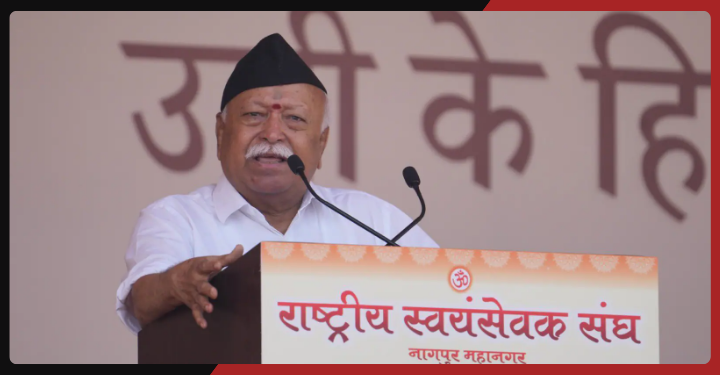
RSS chief Mohan Bhagwat has emphasised national unity, social responsibility and political stability while warning against attempts to bring about regime change in India. Speaking at the Rashtriya Swayamsevak Sangh’s annual Vijayadashami celebrations in Nagpur on October 20, 2026, he referred to developments in France, Albania, Bangladesh and Nepal to argue that political upheavals do not necessarily deliver the solutions people expect.
Thank you for reading this post, don't forget to subscribe!Bhagwat’s address came amid growing political debate over demonstrations connected to the Election Commission. The controversy has highlighted disagreements over electoral administration, institutional accountability and the limits of political protest. By invoking international examples, the RSS chief sought to draw attention to what he views as the dangers of destabilising political campaigns.
A central theme of his speech was the relationship between national development and social cohesion. Bhagwat argued that India’s progress over recent decades, combined with its leadership and the growing sense of national responsibility among citizens, would help the country resist attempts to weaken it.
He also suggested that external interests could take advantage of internal disagreements. According to his assessment, political divisions may create opportunities for forces seeking to influence a country’s direction. These allegations remain his interpretation of international and domestic developments and should be distinguished from independently verified evidence of foreign interference.
National unity is an important issue for a diverse country such as India. Citizens hold different political opinions, follow different social traditions and have varying expectations of public institutions. Maintaining unity does not require eliminating these differences. Rather, it requires a shared commitment to constitutional principles and peaceful ways of resolving disagreements.
Bhagwat’s call for stability therefore intersects with a broader debate about the meaning of democratic strength. One perspective emphasises continuity, effective governance and protection against destabilising activity. Another stresses that institutions remain strong when they are open to scrutiny and capable of responding to public criticism.
These principles need not conflict. An elected government can pursue stable policies while allowing citizens to challenge its decisions. Likewise, opposition parties can demand reforms while recognising the legitimacy of constitutional institutions and peaceful political competition.
The international examples mentioned by Bhagwat illustrate why political transitions require careful examination. A change in leadership may create opportunities for reform, but it can also introduce uncertainty if institutions are weak or political divisions remain unresolved. The outcome depends on the circumstances of each country rather than on a universal rule that political change always succeeds or always fails.
For India, the immediate challenge is to ensure that disputes surrounding electoral procedures are addressed through credible and transparent mechanisms. When allegations arise, relevant authorities should provide clear explanations and follow established procedures. Citizens and political parties should be able to examine evidence and pursue lawful remedies where necessary.
The responsibility also extends to public communication. Political leaders can express strong disagreement without portraying opponents as enemies of the nation. Protest organisers can raise grievances without encouraging violence, and authorities can maintain public order while respecting lawful demonstrations.
Bhagwat’s emphasis on dialogue and solutions offers a framework for reducing tensions, although meaningful dialogue requires participation from all sides and a willingness to address substantive concerns.
His speech ultimately presented national resilience as the answer to political uncertainty. The wider lesson is that a stable democracy needs more than continuity in government. It also needs public trust, accountable institutions, peaceful political competition and effective responses to citizens’ grievances.
As the debate over regime change continues, the ability of India’s political institutions to balance these priorities will be central to maintaining both national cohesion and democratic confidence.


