
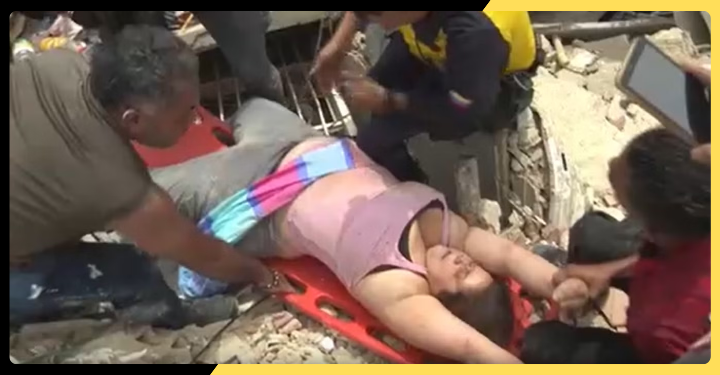
A powerful earthquake that struck Venezuela has left a trail of destruction across several communities, damaging homes, businesses, and public infrastructure. Amid the devastation, however, one extraordinary rescue has captured the attention of people around the world. Emergency responders successfully pulled a woman alive from beneath the rubble of a collapsed building, offering a powerful reminder that hope can endure even in the darkest moments.
Thank you for reading this post, don't forget to subscribe!The earthquake struck with little warning, sending residents rushing out of homes and workplaces as buildings shook violently. Within seconds, some structures partially or completely collapsed, while roads cracked and utility services were disrupted. Emergency hotlines were overwhelmed as families reported missing relatives and sought assistance for those trapped under debris.
Rescue teams were deployed immediately after the earthquake. Firefighters, police officers, emergency medical technicians, military personnel, engineers, and trained volunteers worked around the clock to search damaged buildings. Their mission was both dangerous and urgent, as every passing hour reduced the chances of finding survivors beneath collapsed structures.
At one heavily damaged building, search teams believed someone might still be alive after detecting faint noises from underneath the rubble. Specialized equipment, including thermal imaging cameras, acoustic sensors, fiber-optic cameras, and trained search dogs, helped rescuers narrow down the exact location of the trapped survivor.
The rescue operation required exceptional patience and precision. Engineers first examined the unstable structure to identify potential risks before authorizing responders to begin removing debris. Heavy equipment was used only when necessary, while most of the work was carried out by hand to minimize vibrations that could trigger additional collapses.
For several hours, rescue workers carefully cleared broken concrete, twisted steel, bricks, and other debris while maintaining constant communication with structural experts. Medical teams remained on standby nearby, ready to provide immediate treatment once the survivor was reached.
Eventually, rescuers made contact with the trapped woman. Despite spending hours beneath the collapsed building, she was found alive and responsive. Emergency personnel supplied oxygen, assessed her condition, and carefully secured her onto a rescue stretcher before lifting her safely from the rubble.
As she emerged into the open, the atmosphere quickly shifted from tension to celebration. Fellow rescue workers embraced one another, local residents applauded, and many people watching the operation became emotional. The successful rescue soon spread across television networks and social media platforms, inspiring messages of support from around the world.
The woman was transported to a nearby hospital, where doctors began evaluating her injuries and monitoring her recovery. Earthquake survivors often experience dehydration, fractures, crush syndrome, breathing problems, and emotional trauma after remaining trapped beneath debris. Hospital staff continue to provide comprehensive medical care while monitoring her overall condition.
Although the rescue brought welcome relief, authorities stressed that emergency operations remain far from over. Search teams continue inspecting collapsed buildings throughout the affected region in hopes of locating additional survivors. Officials have also warned residents about the ongoing threat of aftershocks, which can further weaken damaged buildings and create additional hazards for both civilians and rescue workers.
The earthquake caused significant disruption to essential infrastructure. Electricity outages, damaged water systems, blocked roads, and communication failures have complicated relief efforts. Government agencies are working alongside utility providers to restore critical services as quickly as possible while ensuring public safety.
Humanitarian organizations have mobilized to assist affected communities by establishing temporary shelters and distributing emergency supplies. Families displaced by the earthquake are receiving food, clean drinking water, blankets, hygiene kits, clothing, medicines, and other necessities. Mental health professionals are also providing counseling to survivors coping with the emotional impact of the disaster.
Experts say the successful rescue highlights the importance of investing in disaster preparedness, earthquake-resistant construction, and specialized emergency response capabilities. Regular emergency drills, stronger building standards, early warning systems, and well-equipped rescue teams can significantly improve survival rates during major seismic events.
Recovery from a large earthquake is often a long and challenging process. Engineers must inspect damaged structures, governments must rebuild infrastructure, and communities must gradually restore daily life. At the same time, support for survivors remains a critical priority, both physically and emotionally.
While Venezuela continues to face the difficult task of rebuilding after the earthquake, the rescue of one woman from beneath the rubble stands as a symbol of resilience, determination, and hope. It reflects the courage of first responders who risk their lives to save others and reminds the world that even in the midst of widespread destruction, moments of humanity and perseverance can inspire entire communities to keep moving forward.