
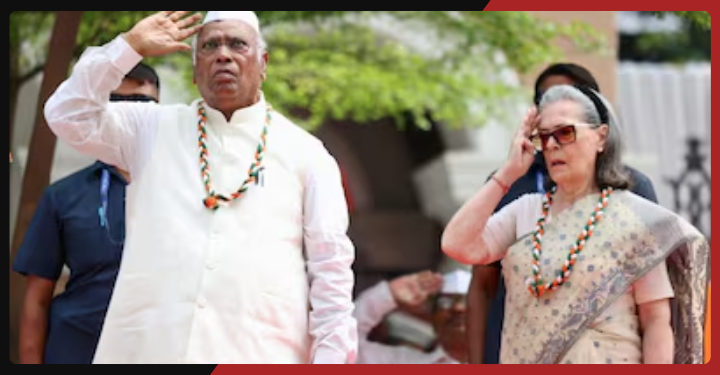
The controversy surrounding Sonia Gandhi and “Vande Mataram” has become one of the major political talking points of Independence Day 2026. A video from the Congress headquarters in Delhi showed Sonia Gandhi making gestures during the rendition of the national song. BJP leaders interpreted those gestures as an attempt to stop the performance, while Congress said the gesture was unrelated to the song and was instead connected to arranging a chair for party president Mallikarjun Kharge.
Thank you for reading this post, don't forget to subscribe!The controversy needs to be understood in the context of this year’s extraordinary focus on “Vande Mataram.” India is observing the 150th anniversary of the national song in 2026. As part of the celebrations, the song was given a prominent role in the Independence Day ceremony at the Red Fort. For the first time, it was performed from the ramparts before the national anthem.
At the Congress headquarters, the Independence Day programme featured senior members of the party. Sonia Gandhi, Rahul Gandhi and Mallikarjun Kharge were among those present. During the rendition of “Vande Mataram,” Sonia Gandhi and Kharge were seen making hand gestures. The footage was recorded and subsequently circulated across social media platforms.
The BJP quickly criticised the Congress leadership. Its leaders said the gestures appeared to show that Sonia Gandhi and Kharge wanted the song to be stopped or interrupted. The allegation was particularly strong because the incident occurred during an Independence Day programme and involved a national song.
Some BJP leaders demanded that Congress explain what happened. Others called for an apology, arguing that the incident amounted to disrespect towards a national symbol.
Congress, however, has completely rejected the accusation.
The party said the complete version of “Vande Mataram” was performed at its headquarters. Congress MP Jairam Ramesh said there was no controversy and dismissed the claim that the party leaders had attempted to stop the song.
Congress also explained Sonia Gandhi’s gesture differently. According to the party, she was asking for a chair for Kharge. The party’s argument is therefore that the gesture had nothing to do with the rendition itself.
The question is whether the video alone can prove either interpretation.
A viral video can establish that a gesture took place, but it cannot always establish why it took place. Without the complete conversation, audio and surrounding context, viewers may interpret the same action differently.
That is the central difficulty in this controversy.
BJP leaders have relied heavily on the appearance of the gesture. They believe the timing and direction of the movement indicate that it was connected to the song.
Congress relies on the context of the event and the fact that the song was ultimately performed in full. Its explanation is that Gandhi was dealing with a seating issue involving Kharge.
Neither side has accepted the other’s interpretation.
The controversy is particularly sensitive because “Vande Mataram” is not simply another patriotic song. It has deep historical importance. Written by Bankim Chandra Chatterjee, it became one of the most recognisable expressions of Indian nationalism during the freedom struggle. After Independence, it was recognised as the national song and given equal honour with the national anthem.
The song has also been at the centre of political and cultural debates for decades. Questions surrounding its later verses and religious imagery influenced decisions about which parts would be used at national gatherings. These historical debates form part of the wider story behind the song’s place in Indian public life.
In 2026, the song has returned to the national spotlight because of its 150th anniversary. The government has promoted its complete version and introduced protocols for its performance at certain official occasions.
That backdrop makes the allegations against Sonia Gandhi especially politically potent.
For the BJP, the episode is an opportunity to argue that Congress should demonstrate greater respect for national symbols. For Congress, it is an opportunity to accuse the BJP of deliberately creating a controversy from an ordinary gesture.
The incident also reflects the increasingly important role of visual politics. In modern Indian politics, a short video can quickly become a national controversy. Political parties can frame the same image in completely different ways, and social media can amplify both narratives simultaneously.
News reports currently confirm the competing accounts. The video shows Sonia Gandhi making gestures. BJP leaders have alleged that the gesture related to stopping “Vande Mataram.” Congress says that is false and that she was arranging a chair for Kharge.
Therefore, it would be premature to present the allegation of intentional insult as an established fact.
A responsible account should say that Sonia Gandhi has been accused of disrespecting or attempting to interrupt “Vande Mataram,” while Congress has denied the allegation. The difference between these two statements is important because the former presents an accusation as fact, whereas the latter accurately describes the disputed nature of the incident.
The political debate is likely to continue. BJP leaders may use the controversy to question Congress’s nationalist credentials, while Congress will continue to defend its leadership and argue that the video has been misrepresented.
Ultimately, the episode is another example of how national symbols can become political battlegrounds. “Vande Mataram” carries historical, emotional and patriotic significance for millions of Indians, making any dispute surrounding its rendition highly sensitive.
For now, the evidence establishes a viral video and a political dispute—not a conclusively proven insult. Congress’s explanation remains that Sonia Gandhi’s gesture was about Kharge’s seating arrangement, while BJP leaders maintain that the footage suggests otherwise.
The final judgment on what exactly happened will depend on the complete context surrounding the video. Until then, the Sonia Gandhi-“Vande Mataram” controversy should be understood as an allegation and rebuttal rather than a settled fact.


