
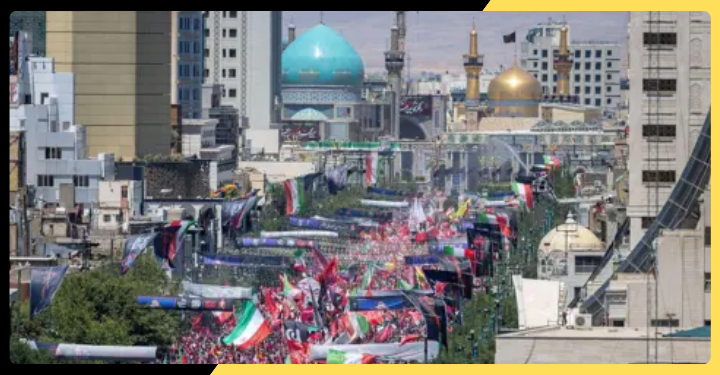
Mashhad, Iran: Iran concluded one of the most significant periods of national mourning in its modern history as hundreds of thousands of people gathered in the holy city of Mashhad for the burial of the country’s late Supreme Leader, Ayatollah Ali Khamenei. The ceremony, held at the revered Imam Reza Shrine, brought to an end a week of funeral processions and memorial events that took place across Iran and Iraq following his death. The burial was attended by senior government officials, military commanders, religious scholars, foreign delegations, and vast crowds of ordinary citizens who traveled from across the country to pay their final respects.
Thank you for reading this post, don't forget to subscribe!Long before dawn, roads leading into Mashhad were filled with buses, cars, and organized convoys carrying mourners from every province. Authorities expanded public transportation services and imposed temporary traffic restrictions to manage the exceptionally large number of visitors arriving in the city. Hotels, guesthouses, and religious accommodations reached full occupancy as pilgrims prepared to attend the historic ceremony.
The streets surrounding the Imam Reza Shrine were decorated with black banners, Iranian flags, and portraits of the late Supreme Leader. Thousands of mourners dressed in black lined the funeral route, carrying flowers, religious symbols, and copies of the Quran. Throughout the day, prayers, Quranic recitations, and religious hymns echoed across Mashhad as people gathered in silence and reflection.
Security across the city was significantly strengthened for the event. Police officers, members of the Islamic Revolutionary Guard Corps, emergency responders, and thousands of volunteers were deployed to maintain order and assist visitors. Security checkpoints were established around the shrine and other major gathering points, while helicopters and surveillance systems monitored crowd movements from above. Medical teams and Red Crescent volunteers remained on standby to provide emergency assistance throughout the ceremony.
The funeral procession began with prayers led by senior clerics before the coffin was carried through designated streets toward the Imam Reza Shrine. State television broadcast the ceremony live, enabling millions of Iranians to follow the proceedings from across the country. Government offices, educational institutions, and many businesses remained closed as Iran observed an official period of national mourning.
President Masoud Pezeshkian, senior ministers, military commanders, and leading religious figures attended various stages of the funeral. Representatives from several allied countries also participated in memorial events, reflecting Iran’s diplomatic and religious ties. Speakers praised Ayatollah Khamenei’s decades of leadership and described his influence on the country’s political system, religious institutions, and regional policies. They also called for national unity as Iran enters a new phase under its successor.
The burial at the Imam Reza Shrine carried deep symbolic importance. Mashhad is both the birthplace of Ayatollah Khamenei and home to one of the holiest shrines in Shiite Islam. Many mourners said the location represented a fitting final resting place, combining personal history with profound religious significance. Pilgrims continued offering prayers inside and around the shrine long after the official burial ceremony had concluded.
Volunteers played a key role throughout the day by distributing drinking water, food, and medical supplies to the large crowds. Community organizations, religious groups, and local charities established assistance centers across Mashhad to help visitors arriving from distant provinces. Despite the enormous turnout, officials reported that the funeral remained peaceful and well organized.
The funeral also carried considerable political significance. Many participants expressed support for the Islamic Republic while chanting slogans reflecting Iran’s continuing tensions with the United States and Israel. Officials described the gathering as a demonstration of national solidarity during a period marked by regional conflict and political transition. International observers closely watched the ceremony, viewing it as an important moment in Iran’s evolving leadership and future direction.
As the final prayers concluded inside the Imam Reza Shrine, the week-long mourning ceremonies officially came to an end. The crowds slowly dispersed from Mashhad, leaving behind a city that had become the focal point of one of the largest public funerals in Iran’s history. With the burial complete, attention is now shifting toward Iran’s new leadership, the country’s economic and diplomatic challenges, and its role in an increasingly complex regional landscape. For many Iranians, the funeral marked not only the end of an era but also the beginning of a new chapter in the nation’s history


