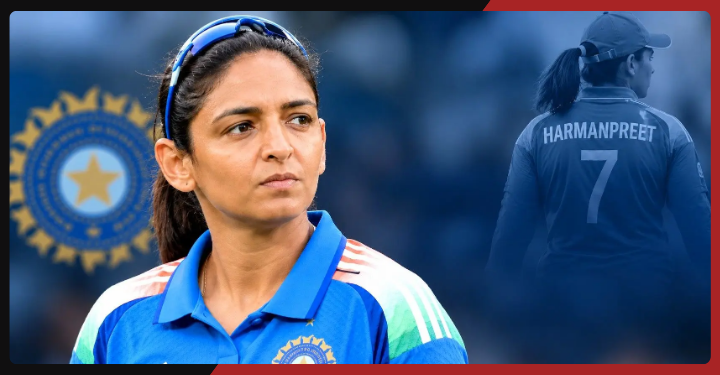
Harmanpreet Kaur’s decision to step down as captain of the Indian women’s cricket team across all formats marks the end of an era and the beginning of another. After years of leading India through major tournaments, historic victories and difficult moments, the veteran cricketer has handed over the responsibility of leadership while choosing to continue her career as a player.
Thank you for reading this post, don't forget to subscribe!The announcement followed a BCCI review meeting in Guwahati involving senior officials and members of the Indian team management. BCCI secretary Devajit Saikia, head coach Amol Muzumdar, Harmanpreet and vice-captain Smriti Mandhana were involved in discussions about the team’s performance and future direction.
The change comes at a particularly important time for Indian women’s cricket. The team has made significant progress in recent years, and expectations have grown considerably. Harmanpreet’s leadership played a major role in that transformation, most notably when India won the Women’s ODI World Cup under her captaincy.
That achievement will remain one of the defining moments of her career. Winning the World Cup gave Indian women’s cricket a historic breakthrough and demonstrated the team’s ability to perform under enormous pressure.
But Harmanpreet’s legacy cannot be measured by one tournament alone.
She became India’s T20I captain in 2016 and later took over as the full-time ODI and Test captain in 2022 following Mithali Raj’s retirement. Her tenure covered a period of substantial change in the women’s game, including greater professional opportunities, stronger domestic structures and the arrival of the Women’s Premier League.
During this period, Indian women’s cricket moved increasingly into the mainstream. Matches attracted larger audiences, players became household names and young girls across the country gained more opportunities to see professional women cricketers as role models.
Harmanpreet was one of the central figures of that transformation.
Her leadership style was often aggressive and highly competitive. She was known for taking responsibility in difficult situations and demanding strong performances from her players. That approach produced memorable victories but also placed her under intense scrutiny whenever results did not go India’s way.
The pressure of international captaincy can be relentless. A captain is judged not only by personal performance but also by team selection, tactics, field placements, bowling changes and the development of younger players. Harmanpreet’s farewell comments highlighted the sacrifices involved in carrying that responsibility for so many years.
Her decision could therefore create an opportunity for both the player and the team.
For India, a new captain can introduce fresh ideas and a different leadership style. For Harmanpreet, stepping away from captaincy provides the chance to concentrate more fully on her own cricket.
The next major question is who will replace her.
Smriti Mandhana appears to be one of the leading possibilities. As vice-captain and one of India’s most experienced players, she already has a strong connection with the leadership group. If appointed, Mandhana would inherit a talented side with significant expectations.
Her challenge would be to maintain the winning mentality developed during Harmanpreet’s tenure while also creating her own identity as captain.
The transition will require careful management. Leadership changes can influence dressing-room dynamics, player roles and tactical approaches. The BCCI and coaching staff will therefore need to ensure that the change is smooth and that the team remains focused on its long-term objectives.
Harmanpreet’s continued presence could help considerably.
Although she has surrendered the captaincy, she is expected to remain available as a player. Her experience could be particularly useful to the next captain during difficult international assignments. She understands the pressures of the role better than almost anyone else in the current squad.
Her contribution can also extend to younger players. Having spent years playing at the highest level, Harmanpreet can help emerging cricketers understand the demands of international cricket and the importance of handling pressure.
The leadership transition also represents a generational shift. Indian women’s cricket now has a deeper pool of talented players than it did when Harmanpreet first became captain. The next phase will be about converting that depth into sustained international success.
The World Cup victory has raised expectations, and India will be judged against an increasingly high standard. Future captains will have to manage those expectations while ensuring that younger players are given the opportunity to develop.
For Harmanpreet, meanwhile, stepping down is not a goodbye to Indian cricket.
It is a change in responsibility.
She has spent years carrying the pressure of leadership, and her decision allows her to focus on playing and contributing in a different way. Her international career can continue without the daily demands of captaincy.
That may ultimately benefit her performances and the team as well.
Harmanpreet leaves the captaincy with a legacy that includes historic victories, major tournaments, difficult decisions and a significant contribution to the growth of women’s cricket in India. Her time as captain helped establish a foundation upon which the next generation can build.
Now the responsibility passes to a new leader.
Indian women’s cricket enters this next phase with an experienced squad, emerging talent and the confidence created by years of progress. The challenge will be to ensure that the end of Harmanpreet’s captaincy does not become an interruption, but instead becomes the beginning of another successful chapter.
The former captain will still be on the field, still wearing the India jersey and still contributing to the team. The difference is that she will no longer have to carry the captain’s burden.
For Indian cricket, that makes this less an ending than a transition.
Harmanpreet Kaur’s era as captain has come to an end, but her influence on Indian women’s cricket is likely to remain for years to come.