
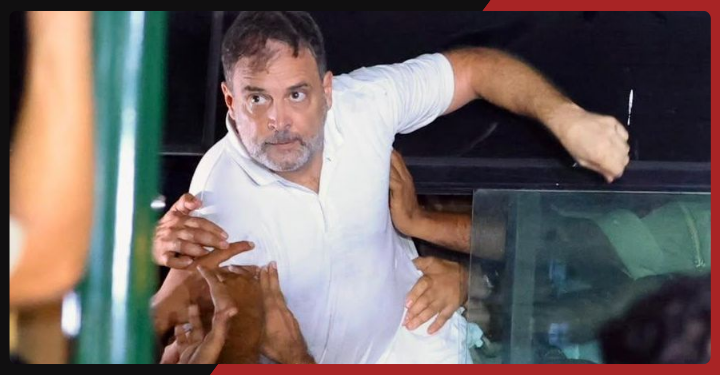
The political campaign led by Rahul Gandhi over alleged irregularities in India’s electoral system intensified on October 6, when the Congress leader was detained by Delhi Police during an opposition demonstration in the national capital. The protest was organised to demand accountability from Chief Election Commissioner Gyanesh Kumar and to raise concerns over the revision of electoral rolls.
Thank you for reading this post, don't forget to subscribe!Gandhi was joined by Priyanka Gandhi Vadra and several other opposition leaders as the INDIA bloc attempted to march towards the Election Commission of India headquarters. The demonstration was part of a wider opposition campaign questioning the Special Intensive Revision of electoral rolls and demanding greater transparency in the process.
The opposition has argued that voter-list revisions require strict safeguards because changes to electoral rolls can directly affect citizens’ ability to participate in elections. Congress leaders have alleged that eligible voters could be excluded from electoral lists and have demanded explanations from the Election Commission. These are political allegations and have been rejected by the Election Commission and the BJP.
The protest began with opposition lawmakers gathering in Delhi before attempting to march towards the Election Commission’s office. Police had deployed barricades to restrict access to the area. As the lawmakers reached the barricades, a tense confrontation developed between protesters and police personnel.
Rahul Gandhi became one of the most visible figures at the protest. He was seen at the barricades holding the national flag while opposition MPs and supporters raised slogans. The Congress leader and his colleagues demanded that the Election Commission meet their delegation.
When the march was prevented from continuing, the opposition leaders shifted their protest to the area around Akashvani Bhavan. Gandhi and Priyanka Gandhi Vadra joined other leaders in a sit-in, signalling that the opposition did not intend to immediately leave the area.
Gandhi said the opposition wanted an opportunity to meet election officials and present its concerns directly. The protest was linked to the Congress campaign around “vote chori”, a phrase the party has used to describe what it alleges are irregularities in the electoral process.
The Election Commission has rejected these allegations and maintained that its electoral-roll revision exercises are intended to improve the accuracy of voter lists. The poll body has said that eligible voters have mechanisms available to raise objections and correct electoral information.
The Commission also disputed the opposition’s account of its attempt to secure a meeting. According to the poll body, it was informed through Delhi Police that a delegation led by Rahul Gandhi wanted to meet at Parliament House Annexe. The Commission said its normal procedure is to hold meetings with political parties at its own premises.
The Election Commission said it offered to send a senior official to receive the opposition’s memorandum. The opposition did not accept the proposal, according to the Commission.
The disagreement over the meeting contributed to the continuing standoff. Opposition leaders argued that the seriousness of their concerns justified direct engagement with the Election Commission’s senior leadership. They also demanded accountability from Chief Election Commissioner Gyanesh Kumar.
The BJP criticised the protest and defended the Election Commission. BJP leaders said the opposition was attempting to create political controversy around an institutional process and questioned the basis of the allegations made by Congress.
The ruling party’s position is that electoral-roll revision is necessary to ensure that voter lists remain accurate and do not contain duplicate, ineligible or otherwise incorrect entries. The opposition, meanwhile, has focused on the possibility that legitimate voters could be affected if verification and deletion procedures are not sufficiently transparent.
The prolonged demonstration eventually ended with police action. Delhi Police detained Rahul Gandhi, Priyanka Gandhi Vadra and several other opposition leaders. They were taken away from the protest location and were later released.
Congress leaders condemned the detention and described the protest as a legitimate democratic demonstration. They argued that elected representatives should be allowed to raise concerns about the electoral process without being detained.
Authorities and the BJP maintained that the police intervention was connected to maintaining public order and managing the protest rather than preventing political criticism of the Election Commission.
The confrontation has nevertheless intensified an already heated national debate about electoral institutions. India’s Election Commission plays a central role in organising elections, maintaining electoral rolls and implementing election-related procedures. Public confidence in the institution is therefore an important component of the country’s democratic system.
Rahul Gandhi’s campaign has sought to place electoral transparency at the centre of the political debate. His supporters argue that opposition parties have a responsibility to question the authorities when they believe voter rights may be affected. Critics, however, say allegations against constitutional institutions should be supported through evidence and addressed through formal mechanisms.
The October 6 protest demonstrates the growing political stakes surrounding the issue. What began as a dispute over electoral-roll revision has developed into a wider confrontation involving opposition parties, the Election Commission, the BJP and law-enforcement authorities.
With Gandhi continuing to demand answers and the resignation of Gyanesh Kumar, the issue is unlikely to disappear quickly. The Congress and its allies are expected to continue raising questions about electoral rolls and demanding greater transparency.
For the Election Commission, the challenge is to maintain public confidence while explaining its procedures and responding to political criticism. For the opposition, the immediate priority remains keeping electoral transparency in the national political debate.
Rahul Gandhi’s detention has therefore become another major moment in the continuing political battle over India’s electoral system. The incident has highlighted the deep disagreement between the opposition and election authorities, while leaving unresolved the broader questions about voter-list revisions, institutional accountability and public trust in the electoral process.


