
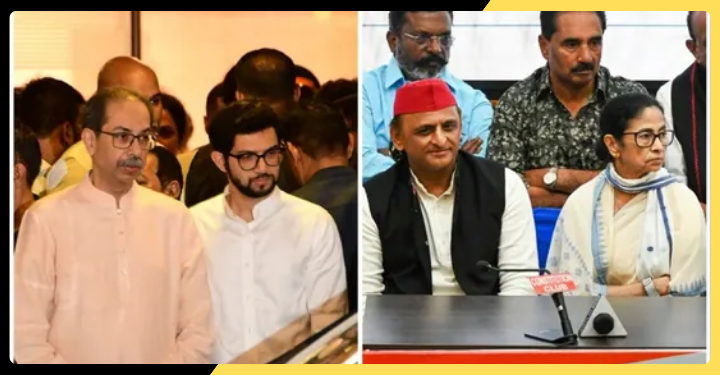
Political parties are often judged by their performance in elections, but the true test of their strength frequently emerges in the period between electoral contests. Organizational unity, leadership authority, and parliamentary discipline play a crucial role in determining political effectiveness. Recent reports of internal dissent within the Trinamool Congress (TMC) and Shiv Sena (UBT) have drawn attention to how party infighting can influence the broader political landscape and potentially create advantages for the National Democratic Alliance (NDA).
Thank you for reading this post, don't forget to subscribe!In parliamentary democracies, political stability is a valuable asset. Parties that maintain unity are generally better equipped to pursue legislative objectives, mobilize supporters, and negotiate alliances. Conversely, internal disputes can divert attention from governance and strategy, forcing leaderships to focus on organizational management rather than political expansion.
The developments within TMC and Shiv Sena (UBT) illustrate the challenges faced by opposition parties operating in a highly competitive political environment. Both organizations occupy important positions within the opposition ecosystem and contribute significantly to efforts aimed at challenging the ruling alliance. As a result, any signs of instability within these parties naturally attract attention from political observers and rivals alike.
For TMC, maintaining internal cohesion has long been a cornerstone of its political success. The party’s leadership structure has traditionally emphasized centralized decision-making and organizational discipline. However, as parties expand and evolve, managing the expectations of diverse leaders becomes increasingly complex. Differences regarding strategy, representation, and political priorities can sometimes generate friction within the organization.
Shiv Sena (UBT) faces a distinct challenge stemming from the political realignment that transformed Maharashtra’s political landscape. The party has spent considerable time rebuilding its organizational framework and strengthening its identity following a major split. While progress has been made, ensuring long-term unity remains a critical objective. Any additional signs of dissatisfaction could create fresh hurdles for party leadership.
The significance of these developments lies not only in their impact on the parties themselves but also in their potential effect on parliamentary politics. Opposition effectiveness depends heavily on coordination. Whether debating legislation, raising public issues, or challenging government decisions, parties must often work together to maximize their influence. Internal disagreements can weaken this process by reducing focus, creating uncertainty, and complicating collective decision-making.
For the NDA, such circumstances may present an opportunity. Political advantages do not always arise from electoral gains or formal defections. Sometimes they emerge from the inability of opponents to act cohesively. A fragmented opposition can make legislative management easier and reduce resistance to government initiatives.
Parliamentary proceedings offer several examples of how internal divisions can influence outcomes. Attendance, voting discipline, and issue-based cooperation are essential components of legislative success. If opposition lawmakers become less coordinated due to internal tensions, the government may encounter fewer obstacles in advancing its agenda.
The Rajya Sabha is particularly relevant in this context. Since governments do not always command overwhelming majorities in the upper house, effective opposition coordination becomes crucial. Small shifts in voting behavior, attendance patterns, or parliamentary engagement can have significant consequences. Internal unrest within opposition parties can therefore alter the balance of influence in subtle but meaningful ways.
Beyond legislative matters, public perception also plays a major role. Political parties are constantly competing to project images of stability, competence, and leadership. Reports of infighting can create doubts among supporters, allies, and undecided voters. In contrast, a party that appears united and disciplined may strengthen its political standing even without making major policy announcements.
The broader opposition alliance framework could also feel the effects of internal disputes. National-level cooperation requires participating parties to remain focused on shared objectives. When major constituents become preoccupied with managing internal challenges, alliance coordination may suffer. This can weaken collective messaging and reduce the effectiveness of opposition campaigns.
Nevertheless, political history demonstrates that internal disagreements do not automatically lead to decline. Many parties have experienced periods of turbulence before successfully restoring unity and regaining momentum. Effective leadership intervention, organizational reforms, and renewed strategic clarity can often help overcome internal challenges.
The coming months will be important in determining whether the current tensions within TMC and Shiv Sena (UBT) remain isolated incidents or evolve into more substantial political issues. Much will depend on how party leaderships address concerns and maintain discipline among their members.
Ultimately, the relationship between party infighting and parliamentary advantage highlights a fundamental reality of politics: numbers alone do not determine influence. Unity, coordination, and organizational resilience are equally important. As opposition parties navigate internal challenges, the NDA may find itself operating in a more favorable environment, demonstrating how political opportunities often emerge from developments beyond election results.
In the end, parliamentary politics is shaped not only by who wins elections but also by who manages their organization most effectively. That reality makes every internal rebellion, leadership dispute, and factional challenge a matter of national political significance.