
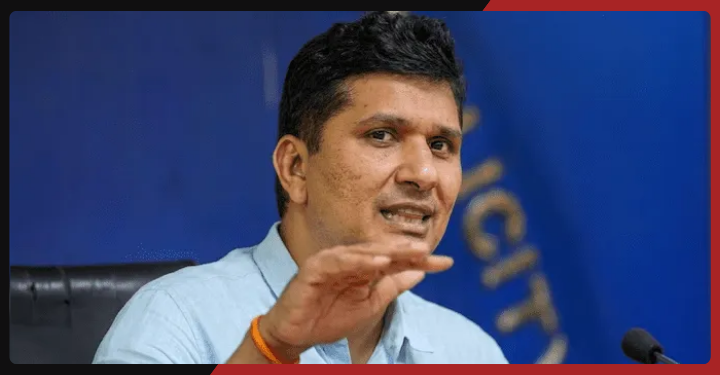
A political battle over government advertisements in Delhi turned into a debate involving two striking figures: ₹97 crore and ₹22,000 crore. The first figure was linked to a recovery order involving advertisements issued by the Delhi government. The second was cited by AAP leader Saurabh Bharadwaj while accusing BJP-ruled states of spending a much larger amount on advertising.
Thank you for reading this post, don't forget to subscribe!The dispute began after Delhi Lieutenant Governor V K Saxena directed the Chief Secretary to recover ₹97 crore from the Aam Aadmi Party over advertisements that were allegedly political in nature but published as government advertisements.
The AAP strongly opposed the move. Bharadwaj questioned the authority behind the order and argued that the action was part of a political campaign against his party.
He then turned the spotlight on advertising expenditure by BJP-ruled states.
According to contemporary reports, Bharadwaj claimed that BJP governments across several states had spent around ₹22,000 crore on advertisements. He argued that these advertisements were also published in media outlets circulated outside the states concerned.
His political challenge was that if Delhi’s advertising practices were being questioned, similar expenditure by other governments should also be examined.
The argument quickly became one of the major talking points in the AAP-BJP confrontation.
However, the figures need to be understood in their proper context.
The ₹97 crore amount was connected to the Delhi government’s advertising controversy. The ₹22,000 crore figure was a claim made by Bharadwaj regarding advertising expenditure by BJP-ruled states.
It was not an official finding that ₹22,000 crore had been illegally spent, nor do the sources reviewed establish it as a proven scam.
This distinction is important because political allegations can be repeated as facts if their origins are not clearly explained.
The wider issue involves government advertising rules. Governments use advertisements to communicate information about public services and policies. These campaigns can be legitimate and sometimes necessary.
For example, a government may need to tell citizens about vaccination, pollution control, welfare schemes, education programmes or emergency measures. Such communication can require significant expenditure, especially when a campaign is designed to reach millions of people.
The problem occurs when public money is allegedly used for political promotion.
Supreme Court guidelines were developed to ensure that government advertisements remain focused on public information rather than promoting political personalities or parties.
The Delhi dispute revolved around whether certain advertisements crossed that line.
The Lieutenant Governor’s office maintained that money should be recovered if advertising rules were violated. The AAP argued that the action was politically motivated and that similar standards were not being applied elsewhere.
Bharadwaj’s ₹22,000-crore claim was therefore a counterargument rather than an independent investigation.
The political context was also important. Relations between the AAP government and the Lieutenant Governor’s office were already strained. Multiple disagreements over governance had created a confrontational atmosphere.
The advertising dispute added another issue to that conflict.
For the BJP, the central question was accountability for government spending. For the AAP, the central question was whether the action against Delhi was selective and politically motivated.
The controversy also raised questions about the use of national media by state governments. Newspapers and television channels often operate across state boundaries. Therefore, governments may argue that advertisements appearing outside their state are still necessary to reach citizens.
Critics can counter that taxpayers should not be asked to finance publicity that is primarily political.
The correct way to resolve such disputes is through transparent records and independent scrutiny. Advertising contracts, invoices, campaign objectives, content and approval processes can establish whether spending complied with the rules.
Political statements alone cannot determine whether a financial irregularity occurred.
The ₹22,000-crore figure therefore remains a political claim attributed to Bharadwaj. It attracted attention because it was dramatically larger than the ₹97-crore amount under immediate dispute.
The episode illustrates how political communication and public finance can become deeply intertwined. Governments need publicity to inform citizens, but that publicity must remain accountable because it is financed by taxpayers.
The controversy also demonstrates the importance of careful journalism. A headline describing the issue as a “₹22,000-crore scam” would imply that the allegation had already been proven. The available reports do not support that conclusion.
A more accurate description is that Bharadwaj alleged approximately ₹22,000 crore in advertising expenditure by BJP-ruled states while opposing a ₹97-crore recovery demand against AAP.
Ultimately, the controversy was less about the headline numbers themselves and more about the principles behind them: transparency, equal application of rules, responsible use of public money and the boundary between government information and political promotion.