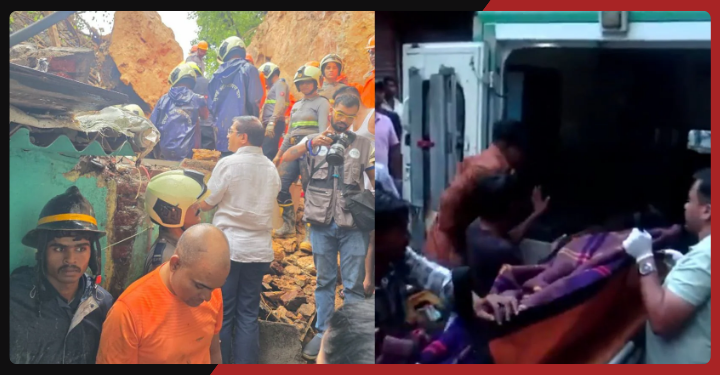
A deadly landslide in Mumbai’s Kurla area has become the latest major tragedy linked to the city’s intense monsoon conditions. The incident at Gaushiya Chawl in Chirag Nagar initially left five people dead and six injured, while later reports raised the death toll to six.
Thank you for reading this post, don't forget to subscribe!The landslide struck around 3:48 am on Wednesday, catching residents during the early hours of the morning. Heavy rainfall had already created difficult conditions across Mumbai, and the saturated ground added to the danger.
The sudden collapse trapped people beneath debris and forced emergency services into action. Fire brigade personnel and other rescue teams arrived at the site and began searching for survivors.
The first few hours after a landslide are critical. People trapped under debris may survive if rescuers reach them quickly, but unstable soil and continuing rain can make the operation extremely difficult.
Emergency workers therefore had to proceed carefully while trying to remove debris and locate victims. The injured were shifted to hospitals for treatment.
The disaster has once again highlighted Mumbai’s vulnerability to extreme monsoon weather. Although heavy rain is a normal part of life in the city, increasingly intense rainfall can create serious threats when combined with vulnerable settlements and unstable terrain.
Kurla is a densely populated area, and the incident has raised concerns about the safety of people living in areas exposed to landslides or other rain-related hazards.
A major challenge for Mumbai is that its population density leaves limited room for relocation. Many families live in established communities that have existed for years, sometimes in locations where redevelopment or evacuation is complicated.
During extreme weather, however, the risks become immediate.
Authorities will need to investigate the cause of the landslide and examine whether the affected location had previously been identified as vulnerable. They may also assess whether drainage problems, slope instability, construction activity or other factors contributed to the incident.
The incident comes as Mumbai continues to deal with the wider impact of the monsoon. Heavy rain can cause waterlogging, traffic disruptions, falling trees, structural damage and landslides. Each of these hazards can become more dangerous when several occur simultaneously.
The tragedy also highlights the need for stronger coordination between weather agencies, civic authorities and emergency services. Accurate rainfall forecasts can help officials identify periods when vulnerable communities face increased danger.
Local residents also play an important role. People living near slopes should pay attention to warning signs such as cracks in walls or ground, unusual sounds, falling rocks or sudden changes in water flow. Such signs can indicate that the ground is becoming unstable.
The casualty figures from Kurla changed as information emerged from the rescue operation. The initial report recorded five deaths and six injuries, while later reporting stated that six people had died.
Behind those numbers are families dealing with sudden loss and injured residents undergoing treatment.
For Mumbai, the incident is a reminder that monsoon preparedness must extend beyond flood management. Landslide-prone locations, vulnerable homes and densely populated settlements also require attention.
The immediate priority remains rescue, medical treatment and assistance for affected families. But after the operation concludes, authorities will have to examine whether additional preventive steps can be taken.
The Kurla landslide is a warning about the unpredictable nature of extreme rainfall. Mumbai has long learned to live with the monsoon, but as weather events become more intense, the city must continue adapting its disaster-management systems to protect residents from increasingly complex risks.