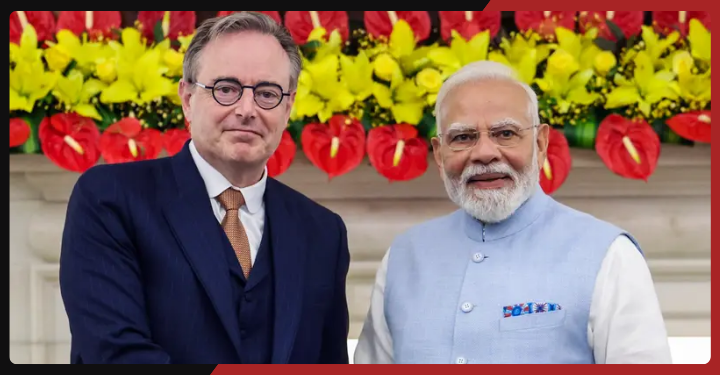
Belgian Prime Minister Bart De Wever has delivered a striking message about Europe’s past economic strategy: India saw the danger earlier.
Thank you for reading this post, don't forget to subscribe!Speaking during his visit to India, De Wever acknowledged that European countries were slow to recognise the risks created by excessive dependence on external economic powers.
India, he said, had warned Europe.
But Europe did not listen.
The statement has generated significant attention because it reflects a broader transformation in global economic thinking.
For many years, countries believed that deeper economic integration would naturally create stability and prosperity. International trade expanded rapidly, supply chains became global and businesses focused on efficiency.
But the modern world has exposed the risks of this system.
A global crisis can interrupt supply chains.
Political disputes can affect trade.
Critical technologies can become difficult to access.
And economic dependence can create strategic vulnerabilities.
Europe is now confronting these realities.
De Wever described the continent’s changing understanding as an awakening that has come late.
His comments suggest that India had recognised the importance of strategic independence much earlier.
Prime Minister Modi’s approach has often emphasised the need for strong domestic capabilities alongside international partnerships.
The goal is not isolation.
It is resilience.
A country can participate actively in global trade while avoiding dangerous levels of dependence on a single source.
That idea has become increasingly important worldwide.
Governments are now investing in domestic manufacturing, building alternative supply chains and strengthening relationships with trusted partners.
Europe is doing the same.
And India is becoming an increasingly important part of that strategy.
De Wever’s comments indicate that Belgium sees enormous potential in deeper cooperation with India.
The relationship is expanding beyond traditional commercial activity.
Defence cooperation is growing.
Technology partnerships are developing.
Clean energy projects are becoming more important.
Critical minerals and semiconductor cooperation are emerging as strategic priorities.
This reflects the new reality of international relations.
Economic partnerships are now closely connected to national security.
Countries want reliable access to essential materials.
They want secure technology supply chains.
And they want partners that will remain dependable during geopolitical crises.
India’s position makes it increasingly valuable.
As one of the world’s largest economies and a major democratic power, India offers Europe an opportunity to diversify its global relationships.
At the same time, India can benefit from European technology, investment and industrial expertise.
The partnership can therefore create advantages for both sides.
De Wever’s admission also carries an important diplomatic message.
European leaders are increasingly recognising India’s strategic perspective.
This could give India greater influence in discussions about the future of global trade and international economic security.
The relationship between India and Europe may therefore become one of the most important partnerships of the coming years.
The Belgian Prime Minister’s statement summarises the changing situation clearly.
Europe was warned.
Europe did not listen.
Europe now understands.
And Europe is looking towards India.
Whether this “late awakening” results in lasting changes will depend on the policies and partnerships developed in the coming years.
But one thing is becoming increasingly clear: India’s voice is carrying greater weight on the global stage.
And according to Belgium’s Prime Minister, Europe has finally started paying attention.