
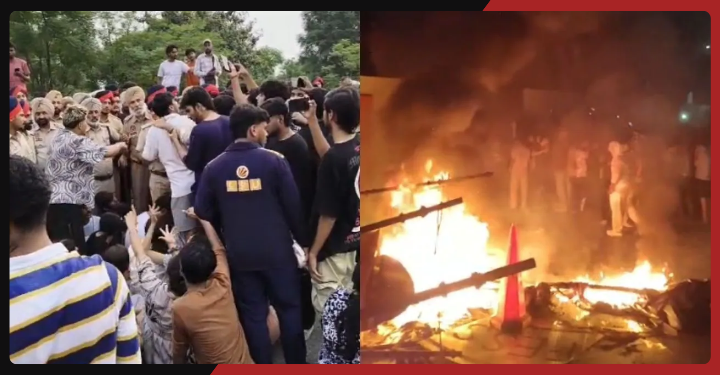
A viral allegation concerning the alleged rape of a female student triggered one of the most serious student protests reported at Lovely Professional University in Phagwara on September 27. Within hours, the controversy moved from social-media platforms to the university campus and then onto a major highway, resulting in vandalism, traffic disruption and a police investigation.
Thank you for reading this post, don't forget to subscribe!The incident began with messages circulating among students about an alleged assault. The messages reportedly contained several details, but authorities did not initially confirm them. Some versions alleged that a construction worker or outsider had assaulted a student, while others linked the allegation to a claim that the student had died by suicide.
Police initially said the information was unverified.
The uncertainty did not prevent students from reacting. Around 2 a.m., a large gathering formed near the girls’ hostel. Students reportedly demanded answers concerning campus safety and the alleged incident.
As the protest continued, the atmosphere became increasingly tense. University property was damaged, including windows and flower pots. Objects were thrown and reports also described fires on campus.
The situation eventually moved toward the university gate. Students then reached the nearby highway and blocked traffic.
The road blockade affected movement between Phagwara and Jalandhar and disrupted traffic on a major regional route. Police forces were deployed to prevent the situation from worsening.
Kapurthala SSP Gaurav Toora reached the campus and spoke to students. He said police had learned that rumours were responsible for bringing students together. He also said officers heard complaints from students about university administration.
The police response was complicated by the changing status of the original allegation. Early statements indicated that no confirmed report of such a crime had been received. Later reporting said police received a student’s statement and registered a case.
DIG Jalandhar Range Naveen Singla said investigators would use technical methods to establish the facts, including forensic examination, CCTV analysis and phone records.
This approach is important because the initial information spread through social media. Social-media posts can provide leads, but investigators must independently establish facts through evidence.
The university administration attempted to counter the online claims by telling students that the messages were misleading. It urged them to stay in their rooms or residences and avoid participating in provocative activities.
Students, however, continued to raise concerns about safety and hostel management. Reports said representatives were expected to meet university officials to discuss their demands.
The incident therefore developed into two interconnected but separate issues.
The first is the alleged sexual assault. Police must establish whether an offence occurred, what circumstances surrounded it and whether there is evidence identifying an offender.
The second is the protest itself. Police must establish who damaged university property, who may have started fires and who participated in blocking the highway.
The two investigations require different forms of evidence.
For the alleged assault, investigators may rely on the complainant’s statement, forensic evidence, medical records where relevant, CCTV footage and digital records.
For the protest, CCTV footage, photographs, videos circulating online and witness statements may help identify individuals involved in vandalism or obstruction.
The incident also raises broader questions about crisis communication at universities. When a serious allegation spreads online, students often want immediate answers. If official communication is delayed, unofficial accounts can fill the gap.
At the same time, universities must avoid confirming allegations before investigators establish the facts. Communicating uncertainty clearly is therefore essential.
The LPU administration’s decision to ask students to remain calm and avoid disruptive activity reflected the need to prevent further escalation. Police deployment similarly focused on restoring order.
The highway blockade made the incident more serious from a public-order perspective. A university protest can affect a limited community, but a highway blockade immediately affects people who have no connection to the dispute.
The police have indicated that legal action will be taken where necessary and that the damage will be assessed.
The controversy has also generated concern among parents and students about residential campus safety. Such concerns can persist even after immediate unrest ends, making follow-up communication and institutional review important.
The most significant lesson from the incident is the danger of allowing an unverified claim to become the foundation for collective action. Serious allegations should be investigated immediately, but rumours should not be treated as established facts.
At the same time, students who raise genuine safety concerns need accessible and credible channels through which their complaints can be heard.
The LPU administration and police now face the task of resolving both aspects of the crisis. Investigators must establish what happened to the student at the centre of the allegation, while authorities must address the consequences of the protest.
The available reports indicate that the situation was brought under control after police deployment. However, the broader controversy is not yet over.
The investigation will determine the factual status of the alleged assault. Discussions between students and university officials may determine whether changes are made to hostel management and security arrangements.
For now, the responsible position is to distinguish clearly between allegation, rumour and verified fact. The alleged rape remains a matter for investigation, while the campus vandalism and highway disruption have already been reported as consequences of the protest.
The events at Lovely Professional University show how quickly information shared online can develop into a major physical confrontation. They also underline the importance of reliable communication, evidence-based investigation and peaceful mechanisms for raising student concerns.


