
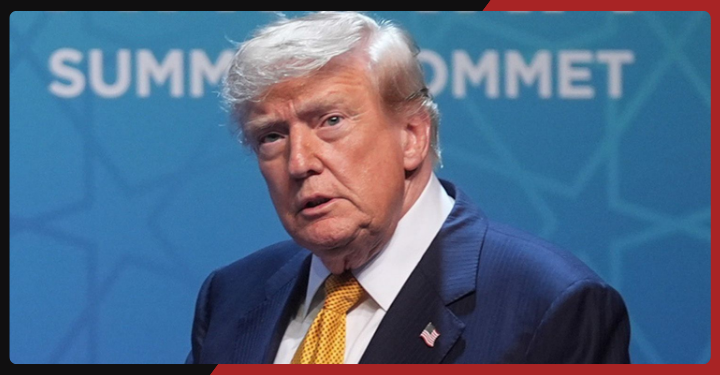
The secret aircraft operation that moved Donald Trump away from the publicly identified Air Force One during his departure from Turkey was already unusual. New information about CIA skepticism toward the underlying intelligence has made the episode even more complicated.
Thank you for reading this post, don't forget to subscribe!Trump was in Ankara for a NATO summit when American security officials reportedly received information about a possible Iranian threat.
The warning had reportedly been passed through Israel.
According to recent reporting, Israeli officials told the United States about an alleged Iranian assassination plot targeting Trump. The information reportedly included concerns that an Iranian-linked group could attack the president or his aircraft.
But CIA analysts reportedly did not regard the intelligence as highly convincing.
The agency reportedly assessed it with low confidence and communicated doubts to Trump administration officials.
Despite that skepticism, the Secret Service took action.
Trump was publicly seen boarding an older Air Force One after the NATO summit. Observers believed that aircraft would carry him onward.
Instead, Trump was reportedly moved secretly from the aircraft using an airport catering vehicle. He was then transferred to a C-32A military aircraft and flown toward Britain.
The aircraft Trump appeared to board effectively became a decoy.
That was important because revealing his true aircraft could have created an additional security risk.
The operation therefore involved not only changing aircraft but also manipulating what observers believed about the president’s movements.
The question now is why such a complicated operation was considered necessary if US intelligence analysts were not convinced that the threat was genuine.
The answer may lie in the difference between intelligence confidence and security responsibility.
The CIA evaluates intelligence.
The Secret Service protects the president.
The CIA can say that a threat is low confidence while the Secret Service can still decide that the possible consequences are too serious to ignore.
That distinction is especially important when dealing with a president who has been the subject of repeated threats.
The reported Iranian warning came against the backdrop of years of hostility between Tehran and Trump.
Iran has repeatedly blamed Trump for the killing of Qasem Soleimani in 2020. US officials have continued to treat threats against Trump and other senior officials as serious security concerns.
The aircraft itself also complicated the situation.
Trump had arrived in Turkey on a new Boeing 747-8 donated by Qatar. The aircraft had been modified for presidential service, but experts have emphasized that it was not originally constructed as a presidential aircraft.
Traditional Air Force One aircraft were built around presidential security requirements.
They contain sophisticated defensive and communications systems intended to protect the president during international travel.
The newer aircraft was modified more quickly, raising questions about whether it possessed exactly the same capabilities.
Reports indicate that this difference contributed to the decision to use the older aircraft during Trump’s departure.
The reported threat also involved a possible missile.
According to recent reporting, US officials were told that a person near the NATO summit may have been observed with a shoulder-fired surface-to-air missile.
The significance of such a weapon is obvious.
A portable missile could potentially threaten an aircraft during takeoff or landing.
But there is no public evidence establishing that an attack was actually underway or that the person reportedly seen with a weapon was connected to Iran.
This is where the CIA’s low-confidence assessment becomes important.
It shows that intelligence officials were not necessarily convinced by the complete picture.
Yet presidential protection rarely allows officials to wait for perfect information.
A low-probability threat with potentially catastrophic consequences can justify extraordinary precautions.
Trump later confirmed that the Secret Service was responsible for the aircraft change and said he followed its instructions.
The operation reportedly involved only a small group of aides. Other officials and journalists remained aboard the visible aircraft.
That helped maintain the deception.
The aircraft carrying Trump reportedly flew to Britain and was escorted by fighter aircraft during part of the journey.
The incident has now produced several major questions.
First, how credible was the original intelligence?
Second, why did Israel pass the information to Washington?
Third, how much independent US intelligence supported the warning?
Fourth, why was the newer presidential aircraft not considered the preferred option?
And finally, did the Secret Service make the right decision by acting despite intelligence doubts?
There are no complete public answers to these questions.
Some American officials have reportedly suggested that Israeli intelligence about Iran may sometimes reflect Israel’s broader strategic priorities.
That does not establish that the warning about Trump was deliberately misleading.
It does show why US agencies would want to verify foreign intelligence before accepting it as fact.
The Turkey operation therefore offers a rare glimpse into how governments handle uncertainty at the highest level.
Intelligence analysts can disagree.
Security officials can still act.
And presidents can be moved secretly without the public knowing their true location until afterward.
For Trump, the operation appears to have succeeded in its immediate objective: he safely left Turkey.
For US intelligence agencies, however, the episode leaves behind a more difficult question.
Was the threat real, or did officials respond to intelligence that was never strong enough to prove an imminent danger?
That question may remain unanswered unless more classified information becomes public.