
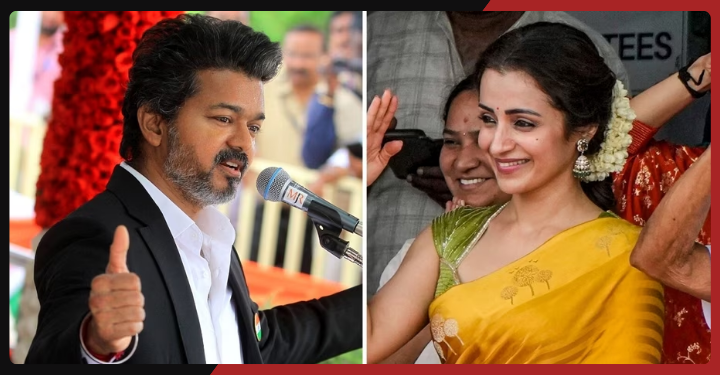
Tamil Nadu Chief Minister C. Joseph Vijay has raised serious concerns about what he describes as a growing culture of vulgarity, hatred and degrading language in public political discourse.
Thank you for reading this post, don't forget to subscribe!In a strong address in the Tamil Nadu Assembly, Vijay criticised the use of abusive words, defamatory statements and double-meaning expressions against women.
His comments came amid the controversy surrounding alleged remarks linked to actor Trisha Krishnan, but the Chief Minister used the occasion to address a much larger issue: the changing language of politics.
Vijay said people were watching political leaders and paying close attention to the way they spoke.
His message was directed at a political culture in which speeches are often designed to go viral, social media clips can become major controversies and personal attacks sometimes receive more attention than serious policy discussions.
The Chief Minister warned that freedom of expression should not become a licence for humiliation.
He accepted that political criticism was a legitimate part of democracy.
Leaders should be able to question governments.
Opposition parties should challenge those in power.
Strong disagreement, according to Vijay, is natural in politics.
But there must be limits.
When criticism turns into personal degradation, especially against women, it damages not only the person being targeted but also the standards of public debate.
Vijay’s remarks followed the political controversy involving Udhayanidhi Stalin and actor Trisha.
During a Cauvery-related protest in Thanjavur, supporters reportedly shouted Trisha’s name while Stalin was speaking.
A comment made afterward was interpreted by critics as a double-meaning reference to the actor.
The incident quickly spread across social media.
TVK leaders condemned the alleged remark, while Udhayanidhi Stalin denied making an inappropriate comment about Trisha.
He argued that his statement was connected to the Cauvery issue and had been politically misinterpreted.
The controversy became another major dispute between Tamil Nadu’s ruling and opposition parties.
But Vijay’s Assembly speech focused on something broader than the disagreement over one viral video.
He spoke about what he saw as an increasing “river” of obscenity and malice flowing through public discourse.
That description reflected his concern that offensive language is becoming normalised.
The rise of social media has transformed political communication.
A politician can now speak directly to millions of people without waiting for newspapers or television channels to interpret the message.
But this direct communication has also created incentives for sensationalism.
The more controversial a statement is, the faster it can spread.
This has created a political environment where provocative language can sometimes appear more effective than thoughtful debate.
Vijay’s warning can therefore be understood as a call for greater responsibility.
He reminded politicians that public speeches influence society.
When influential leaders use insulting or degrading language, their words can shape how ordinary people speak about women and political opponents.
The Chief Minister’s remarks also carried a warning about accountability.
People are watching, he said.
In the modern political environment, citizens can record speeches, replay statements and judge leaders based on their own words.
Vijay also invoked the historical experience of former Chief Minister Jayalalithaa, referring to the humiliation she faced in the Assembly.
By doing so, he connected the present controversy to Tamil Nadu’s political history and suggested that society must not repeat the mistakes of the past.
His message was ultimately about dignity.
Political parties may compete.
Leaders may disagree.
Elections may create fierce rivalries.
But public life should not become a competition to see who can deliver the most offensive personal attack.
The controversy surrounding Trisha may have triggered Vijay’s intervention, but his speech has opened a larger debate about the future of political language in Tamil Nadu.
His position is clear: democracy needs criticism.
But democracy does not need vulgarity.


