
Cochin Shipyard Limited has reached a major milestone in a ₹9,804-crore programme to build six Next Generation Missile Vessels for the Indian Navy. The keel of the first vessel was laid at CSL’s Kochi facility on September 18, 2026, advancing one of India’s latest naval shipbuilding projects.
Thank you for reading this post, don't forget to subscribe!The six-vessel contract was signed between CSL and the Indian Navy on March 30, 2023. CSL disclosed the value of the contract as approximately ₹9,804 crore when announcing the steel-cutting milestone for the first ship in December 2024.
The keel-laying ceremony was attended by Vice Admiral Sanjay Sadhu, Controller of Warship Production and Acquisition, who served as chief guest. Senior officials from the Navy and CSL were also present.
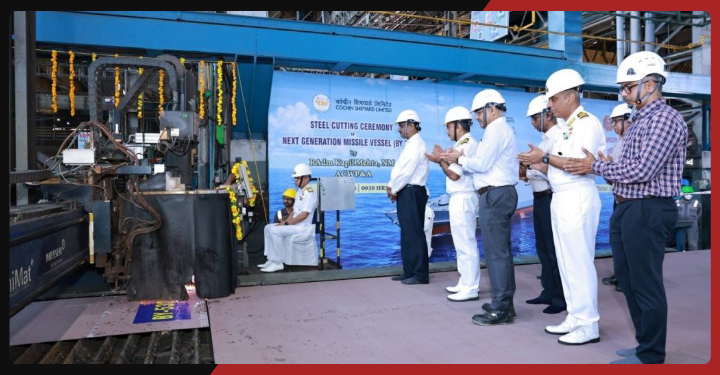
The first NGMV had already crossed its initial construction milestone in December 2024, when the first steel plate for Ship No. BY-531 was cut. Since then, construction has progressed towards the keel-laying stage.
The programme is not limited to the first ship. Steel cutting for the second NGMV was conducted at CSL on September 17, 2026, one day before the keel-laying ceremony for the first vessel. The event was attended by Rear Admiral Kapil Mehta, Assistant Controller of Warship Production and Acquisition.
The NGMVs are intended to be high-speed vessels equipped with advanced weapons and sensors. The Ministry of Defence says the systems planned for the ships are expected to enhance the combat capabilities of the Indian Navy.
Earlier official information about the programme described the planned equipment as including surface-to-surface missile systems, anti-missile defence systems, air-surveillance radars and fire-control radars. These systems are intended to support both offensive and defensive naval operations.
The vessels are expected to support maritime strike and anti-surface warfare missions. Their planned responsibilities also include local naval defence and the protection of offshore development areas. Reports have further described the platforms as potentially useful for sea-denial missions, particularly around maritime choke points.
The high-speed nature of the vessels is another defining feature. The Times of India reported a planned maximum speed of up to 33 knots and a crew size of around 80 personnel.
The programme has considerable significance for India’s domestic defence industry as well. The Ministry of Defence has stated that major role-defining equipment for the NGMVs is being indigenously developed and manufactured. This supports the government’s stated goals of Aatmanirbhar Bharat, Make in India and Make for the World.
CSL’s role is particularly noteworthy. The New Indian Express reported that the NGMV contract marks the shipyard’s entry into construction of advanced weapon-intensive platforms for the Indian Navy.
For a shipyard, building a modern missile vessel involves more than conventional hull construction. The vessel must accommodate weapons, radars, communications equipment, propulsion systems and other specialised systems. These components must eventually operate together as an integrated combat platform.
The NGMV programme therefore requires coordination between the shipyard, Navy, equipment suppliers and other organisations involved in naval construction and certification.
The project also reflects India’s broader attempt to increase the domestic contribution to defence production. Indigenous equipment development can support local manufacturing capabilities while reducing reliance on foreign sources for certain critical systems.
At the operational level, the six NGMVs are expected to provide the Indian Navy with another category of surface combatant. They will complement, rather than replace, larger naval platforms that perform different roles.
The September 18 keel-laying ceremony is therefore an important marker in the programme’s timeline. The first vessel is moving through its construction phase, while the second ship has already entered fabrication.
The next stages will involve continued hull construction and the installation and integration of equipment. After construction is completed, the vessels will have to undergo testing and trials before they can enter operational service.
For the Indian Navy, the eventual completion of all six vessels will add a new class of high-speed missile platforms to the fleet. For Cochin Shipyard, the programme represents an opportunity to expand its role in sophisticated naval construction.
The NGMV programme thus combines naval modernisation, domestic shipbuilding and defence-industry development. The keel laying in Kochi is the latest milestone in that process, with further construction and testing phases still ahead.


