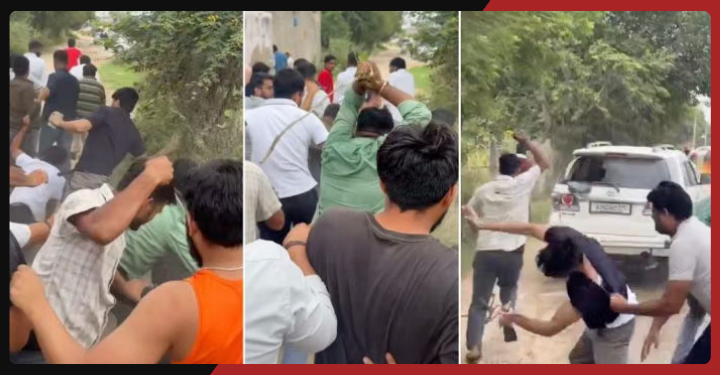
What began as a campaign to inspect government schools in Rajasthan has rapidly developed into a political confrontation involving the Cockroach Janta Party, local residents and the state administration. The latest flashpoint came on Friday when CJP members visiting a government school in Jaipur district were reportedly confronted and chased away.
Thank you for reading this post, don't forget to subscribe!CJP has described the incident as an attack on its volunteers. Founder Abhijeet Dipke alleged that co-convenor Ashutosh Ranka and other members were assaulted and that vehicles were damaged. The organisation has accused individuals allegedly associated with the BJP of involvement. Those allegations remain disputed.
The campaign behind the controversy is called “School Thik Karo”. CJP says its purpose is to encourage citizens to examine government schools and report problems with infrastructure and basic facilities. The organisation says its volunteers have documented issues including locked toilets, inadequate water, damaged classrooms, poor sanitation and shortages of teachers.
In Rajasthan, the campaign gained momentum after CJP announced plans to visit schools in several districts. Ashutosh Ranka said the organisation had received requests from residents seeking inspections in Jaipur, Ajmer, Jodhpur, Udaipur, Dholpur, Bharatpur, Kota, Barmer and Hanumangarh.
The campaign then collided with a government access order. Rajasthan’s Directorate of Secondary Education directed government schools to prevent outsiders from entering without permission. It also restricted unauthorised photography, videography, interviews and live streaming. Officials said the purpose was to protect students’ privacy, dignity and safety.
The timing immediately became controversial. CJP had announced its inspection plans shortly before the government directive. The organisation viewed the restrictions as an obstacle to its campaign, while the government presented them as child-safety measures.
Against this already tense backdrop, the CJP team travelled to Rampura-Kanwarpura. Ranka said the school was allegedly being run from a buffalo shed and that the team wanted to document the situation. When the group arrived, local residents reportedly confronted them. Videos from the incident show a tense scene in which CJP members were chased away.
The villagers’ account differs significantly. Reports indicate that residents objected to the political nature of the CJP visit and argued that the school was already receiving government support. A development amount of around Rs 12.5 lakh was reportedly cited by locals in relation to the school.
This disagreement illustrates why local school issues can become politically sensitive. Residents may welcome improvements but still oppose outsiders arriving without consultation. At the same time, activists may argue that public institutions require independent scrutiny when official complaints have not produced results.
The question of who was responsible for the alleged violence must be settled separately. CJP has alleged assault and vehicle vandalism, while local residents have disputed aspects of its account. Police and administrative authorities would need to examine video evidence, eyewitness statements and any complaints filed by those involved.
CJP has now threatened to intensify its campaign. The organisation has demanded action against those it accuses of attacking its members and has reportedly given the Rajasthan government a 48-hour deadline. It has also criticised Education Minister Madan Dilawar and demanded accountability over school infrastructure.
The confrontation could have wider implications. If political groups continue conducting unauthorised school visits, education authorities may strengthen restrictions further. If authorities rely solely on restrictions without providing transparent information about school conditions, critics may accuse the government of avoiding scrutiny.
A better approach would involve institutionalised transparency. Schools could publish basic infrastructure data, repair schedules and government allocations. Parents could be given formal complaint mechanisms. Independent inspections could be carried out through authorised committees involving education officials and community representatives.
Such measures would address the underlying problem without putting students in the middle of political confrontations.
The CJP campaign has clearly succeeded in generating attention. But attention alone cannot repair a classroom or provide a functioning toilet. Real improvement requires funding, implementation, monitoring and accountability.
The latest Rajasthan incident should therefore be seen as both a political controversy and a warning. Government schools need scrutiny, but that scrutiny must be conducted responsibly. Political organisations must respect school rules, while governments must ensure that rules do not prevent legitimate concerns from being raised.
Ultimately, the success of any school-reform campaign should be measured not by the number of viral videos or political clashes, but by whether children receive safer and better schools.