
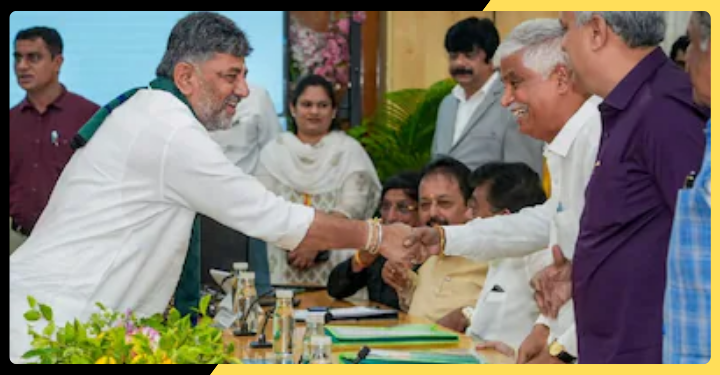
The Karnataka Congress government is facing a period of political uncertainty after a Cabinet reshuffle triggered widespread dissatisfaction within the ruling party. The resignation of two Congress MLAs has intensified concerns over internal unity, while reports of growing discontent among several other legislators have added to the pressure on the party leadership. What was intended to strengthen the government has instead evolved into a significant political challenge, forcing the Congress to focus on damage control while the opposition watches closely.
Thank you for reading this post, don't forget to subscribe!The Cabinet reshuffle was announced following weeks of discussions between the state leadership and the Congress high command. The primary objective was to improve governance, introduce administrative efficiency, and maintain a balance of regional, social, and political representation. However, the exercise also created disappointment among many legislators who believed their experience, loyalty, and contribution to the party deserved recognition through ministerial appointments.
The political crisis deepened when two Congress MLAs decided to resign, citing dissatisfaction with the Cabinet formation process. The legislators claimed that the leadership had failed to recognize deserving leaders and that the selection process lacked transparency. They argued that several experienced lawmakers who had worked extensively for the party were ignored despite their consistent commitment and electoral success.
Their resignations have sparked speculation that additional legislators could also express their unhappiness if their concerns remain unresolved. While many dissatisfied MLAs have chosen not to speak publicly, reports suggest that internal meetings have taken place among party members to discuss the recent developments. Political observers believe that the leadership’s response over the coming days will determine whether the crisis can be contained or expands into a larger rebellion.
Chief Minister Siddaramaiah has appealed to party legislators to remain united and focus on governance. Addressing concerns over the Cabinet reshuffle, he stated that constitutional restrictions limit the number of ministers who can be appointed, making it impossible to accommodate every deserving legislator. He emphasized that all MLAs continue to play an important role in the functioning of the government, regardless of whether they hold ministerial positions.
Deputy Chief Minister D.K. Shivakumar has also made efforts to reduce tensions within the party. He has held discussions with several legislators and urged them to resolve differences through dialogue rather than public confrontation. According to Shivakumar, the Congress remains committed to maintaining unity and ensuring that every leader receives opportunities to contribute to the government and the organization in the future.
The Congress high command has reportedly stepped in to closely monitor the situation. Senior leaders from the national leadership are believed to be communicating regularly with the Karnataka unit to prevent further resignations and reassure dissatisfied legislators. Party sources indicate that discussions are underway regarding future organizational responsibilities and possible Cabinet adjustments that could help address the concerns of unhappy lawmakers.
The opposition Bharatiya Janata Party (BJP) has used the controversy to criticize the Congress government. BJP leaders argue that the resignations reveal serious factionalism within the ruling party and demonstrate its inability to manage internal affairs effectively. They claim that the Congress leadership is preoccupied with power-sharing disputes while important issues affecting the people of Karnataka require immediate attention.
Political analysts note that Cabinet reshuffles often generate expectations among legislators, particularly in governments with comfortable legislative majorities. Since constitutional provisions restrict the total number of ministers, many deserving leaders are inevitably left out. Such situations frequently lead to disappointment, making effective political management essential to maintaining unity within the party.
The developments come at a time when Karnataka is focusing on several important governance priorities, including infrastructure development, employment generation, industrial investment, agricultural reforms, and the implementation of social welfare programmes. Experts warn that prolonged political instability could divert the government’s attention from these issues and affect public confidence in its ability to deliver on election promises.
Despite the current unrest, many Congress leaders believe the crisis remains manageable. They argue that internal disagreements are a common feature of democratic politics and can be resolved through communication, compromise, and organizational adjustments. However, they also acknowledge that swift action is necessary to prevent dissatisfaction from spreading further within the legislative party.
For the Congress leadership, the present situation represents a crucial test of political leadership and organizational discipline. Balancing the aspirations of senior legislators while maintaining an effective government requires careful negotiation and consensus-building. Failure to resolve the dispute could not only weaken party unity but also strengthen the opposition’s political narrative ahead of future elections.
As discussions continue behind closed doors, the coming weeks are expected to be decisive for Karnataka politics. Whether the Congress succeeds in restoring internal harmony or faces further resignations will significantly influence the stability of the state government. For now, the Cabinet reshuffle has transformed into a defining political challenge, testing the party’s ability to manage competing ambitions while remaining focused on governance and public welfare.


