
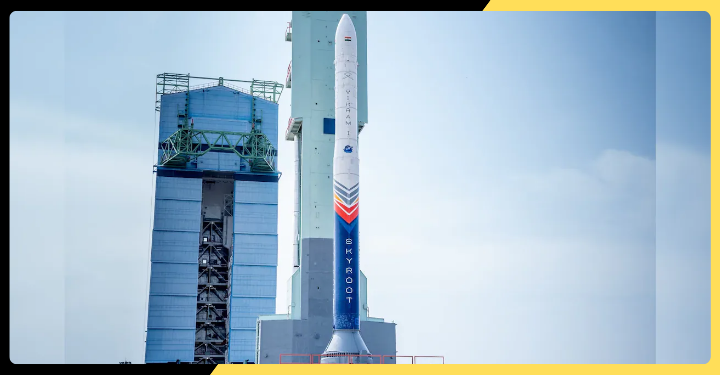
The successful orbital mission of Vikram-1 is a defining achievement for Skyroot Aerospace and a landmark event for India’s private space industry. By demonstrating that a privately developed Indian rocket can successfully reach orbit, the Hyderabad-based startup has showcased the growing maturity of the country’s commercial aerospace sector. The mission has generated excitement among investors, policymakers, scientists, and entrepreneurs, signaling that India is entering a new era where private companies play an increasingly important role in space exploration and satellite launches.
Thank you for reading this post, don't forget to subscribe!Yet, despite the celebration surrounding Vikram-1’s success, Skyroot’s most important mission is only beginning. History has shown that many companies achieve technological breakthroughs but struggle to transform those achievements into sustainable businesses. In the highly competitive commercial space industry, success is measured not by a single launch but by the ability to consistently deliver reliable services, attract customers, maintain profitability, and adapt to rapidly changing market conditions.
Skyroot Aerospace was established with an ambitious vision—to make access to space more affordable, flexible, and efficient. Founded by former engineers from the Indian Space Research Organisation (ISRO), the company sought to capitalize on advances in rocket technology and the growing demand for small satellite launches. Over the years, Skyroot invested heavily in research and development, introducing innovations such as lightweight carbon composite structures, modular rocket architecture, and 3D-printed propulsion components. These technologies are designed to reduce production costs while improving manufacturing speed and operational efficiency.
The successful Vikram-1 launch validates these engineering efforts. Reaching orbit requires flawless coordination of propulsion systems, structural design, guidance software, stage separation, and mission control. Even small technical errors can lead to mission failure, making every successful orbital launch an extraordinary accomplishment. For Skyroot, Vikram-1 has established technical credibility both within India and in the international space community.
However, commercial credibility is built differently. Satellite operators, government agencies, and private companies seek launch providers with proven reliability over multiple missions. Customers often invest millions of dollars in satellite payloads, making launch selection one of the most important decisions in any space mission. A provider with a consistent record of successful launches is naturally viewed as a lower-risk partner than a newcomer with limited operational history.
This means Skyroot’s next objective is clear: demonstrate consistent performance through regular commercial launches. A steady launch schedule not only builds customer confidence but also creates recurring revenue that supports future research, infrastructure development, and workforce expansion. Without a reliable flow of commercial missions, even the most impressive technological achievements may struggle to generate long-term financial returns.
The market opportunity is certainly promising. The global space economy continues to expand as industries increasingly rely on satellite-based services. Telecommunications, Earth observation, navigation, weather forecasting, agriculture, environmental monitoring, defense, disaster management, and scientific research all depend on satellites. Advances in miniaturization have made satellites smaller, cheaper, and more capable, leading to a surge in demand for launch services tailored to small payloads.
Skyroot’s launch vehicles are well positioned to serve this growing market. Dedicated launches offer customers greater flexibility than rideshare missions, allowing them to choose launch schedules and orbital destinations that match their operational requirements. This customer-focused approach could become one of the company’s strongest competitive advantages.
Nevertheless, the global launch market is highly competitive. Established aerospace companies have accumulated years of operational experience, extensive customer relationships, and significant financial resources. Many are investing in reusable rocket technology, automated production systems, and integrated space services that reduce costs while improving operational efficiency. To compete effectively, Skyroot must continue innovating while maintaining strict cost control.
Financial management will also be crucial. Rocket development requires continuous investment in testing, manufacturing facilities, launch infrastructure, quality assurance, and highly skilled personnel. As the company grows, balancing investment with revenue generation will become increasingly important. Investors who initially supported technological development will now expect commercial success measured through revenue growth, customer acquisition, profitability, and operational scalability.
India’s evolving space policy provides favorable conditions for companies like Skyroot. Regulatory reforms have opened the sector to private participation, encouraged innovation, and created opportunities for collaboration with national space institutions. These policy changes have attracted domestic and international investment while positioning India as one of the world’s fastest-growing commercial space markets.
Looking ahead, diversification could strengthen Skyroot’s long-term business model. Beyond launch services, the company may expand into satellite deployment, orbital transfer vehicles, propulsion systems, mission planning, spacecraft integration, and future space logistics. Offering comprehensive mission solutions would increase revenue opportunities while strengthening relationships with commercial customers.
International expansion is another promising avenue. Many countries and emerging space organizations require affordable launch services but lack domestic launch capabilities. By establishing a reputation for reliability, competitive pricing, and responsive customer support, Skyroot could secure contracts from customers across Asia, Africa, Europe, and Latin America, further strengthening its position in the global market.
The successful Vikram-1 mission has undoubtedly opened the door to a new chapter in India’s private space story. It proves that Indian startups possess the talent, innovation, and determination to compete in one of the world’s most technologically demanding industries. However, true success will be defined not by reaching orbit once but by building a resilient business capable of delivering value year after year.
If Skyroot can combine engineering excellence with strong commercial execution, it has the potential to become far more than a successful startup. It could emerge as a global leader in small satellite launches, inspire a new generation of Indian aerospace entrepreneurs, and play a central role in transforming India into a major force in the international space economy. Vikram-1 has opened the door to space; now Skyroot must prove it can build a lasting business that stands the test of time.