
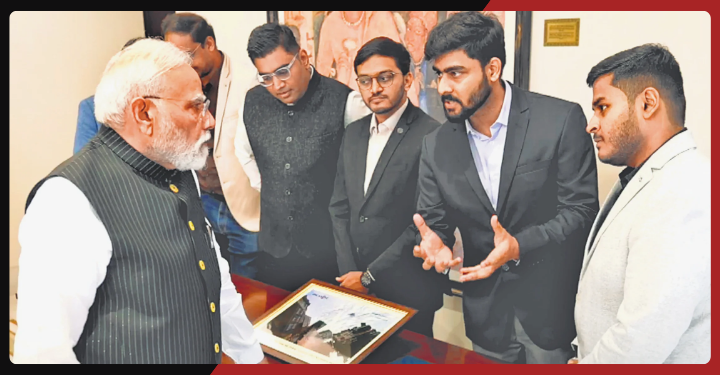
Prime Minister Narendra Modi has outlined an ambitious vision for India’s space industry, calling on Indian startups to reach a stage where the world begins looking towards the country for new space technologies, businesses and talent.
Thank you for reading this post, don't forget to subscribe!During an interaction with CEOs and founders of 20 space startups, Modi said India could establish itself very quickly in the global space sector. He identified cost competitiveness, technical talent and India’s willingness to take risks as major strengths.
The Prime Minister’s remarks come as India’s space sector undergoes a major transformation. Private companies are increasingly entering areas ranging from rocket development and satellite manufacturing to propulsion, artificial intelligence and Earth observation.
The government has been encouraging this transformation through policy reforms designed to increase private participation. Official figures released in July said private investment had crossed $618 million and 105 authorisations had been issued to private entities.
The number of startups has also increased significantly. The government said India’s private space ecosystem had expanded to more than 400 startups by June.
Modi now wants this domestic growth to translate into global influence.
His call for creating an “aura” around India’s space industry is essentially a demand for international recognition. The country should become a place where global professionals want to work, international investors want to invest and companies want to establish operations.
Such a transformation could provide India with several advantages. Foreign investment can increase access to capital, international talent can strengthen technical capabilities, and global customers can help Indian startups scale their businesses.
However, becoming a global space hub will require sustained efforts. Space companies operate in a capital-intensive and technically demanding environment. They require reliable infrastructure, testing facilities, research capabilities, skilled employees and regulatory clarity.
Modi highlighted policy consistency as an important component of this environment. Entrepreneurs must have confidence that government decisions will remain stable while they make long-term investments.
The Prime Minister also wants startups to explore applications beyond traditional space missions. He encouraged companies to work with agriculture, environmental and other social-development sectors.
This could allow Indian space companies to build businesses around practical challenges while simultaneously demonstrating the wider value of space technology.
The meeting included companies working on rockets, reusable launch vehicles, satellites, propulsion, avionics, intelligence, space debris and AI-powered weather and climate systems.
The range of technologies shows how India’s space industry is becoming more diversified.
Education is another important part of the long-term strategy. Modi called for greater cooperation with Atal Tinkering Labs to encourage curiosity about space among young students. Developing interest early could help create a future generation of scientists, engineers and entrepreneurs.
The Prime Minister’s vision therefore covers the entire space ecosystem—from schools and startups to investors and international markets.
India has already demonstrated that it can achieve complex space missions at competitive costs. The next challenge is turning those capabilities into a large and globally connected commercial industry.
For Indian startups, the opportunity is significant. They can build on domestic expertise while targeting international customers and partnerships.
For the government, the challenge will be ensuring that policy support, infrastructure and investment keep pace with the industry’s ambitions.
Modi’s message ultimately represents a shift from asking whether India can participate in the global space sector to asking how quickly it can become one of its major centres.
With a growing startup ecosystem, increasing private investment and expanding technological capabilities, India is positioning itself for a larger role in the global space economy. The success of that strategy will depend on whether the country can turn its existing advantages into sustained innovation, global business and world-class talent.


