
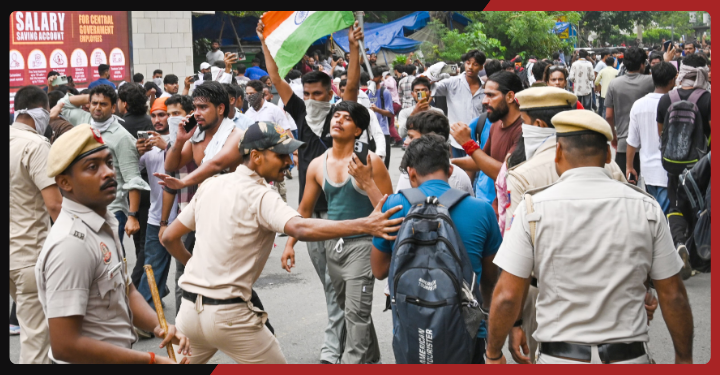
Delhi Police’s latest reported guidelines for dealing with Gen Z protesters highlight a fundamental change in India’s protest landscape. Demonstrations are increasingly being conducted in front of cameras, with smartphones, reels and social-media platforms becoming an important part of how young people document and communicate their movements.
Thank you for reading this post, don't forget to subscribe!Following the Jantar Mantar protests, police personnel have reportedly been advised to remain calm, avoid unnecessary arguments and remember that their reactions may be recorded and circulated online.
The most memorable message from the reported advisory is that an officer’s angry face can become protesters’ content. The warning reflects the reality that a heated exchange can quickly become a viral video.
Personnel have reportedly been instructed not to respond to provocative questions or emotional appeals. If they need to speak, they can use a simple statement asking protesters to cooperate because officers are performing their duties. Otherwise, they have been advised to remain silent.
This strategy is particularly relevant when dealing with younger demonstrators who understand how social-media algorithms work. A dramatic confrontation is likely to attract far more attention than a calm interaction.
The reported guidelines therefore seek to remove the drama from police-protester exchanges.
The advisory reportedly warns that protesters may use different emotional approaches, including crying, personal appeals and questions concerning family or financial difficulties. Police personnel have been told not to enter into debates or show agreement during such encounters.
The message is not simply “do not speak.” It is “do not lose control.”
Another part of the reported guidance concerns interactions with women protesters. Police personnel have been asked to avoid unnecessary physical contact with women wherever possible and allow women police officers to manage such situations.
The broader context is the growing role of social media in youth activism. Recent reporting has described how India’s Gen Z protesters have used humour, memes, reels and online communication alongside traditional demonstrations.
This represents a significant change from older protest movements, where posters, speeches and newspaper coverage were the primary tools for spreading a message.
Today, a protester with a smartphone can become a reporter, videographer and publisher simultaneously.
For authorities, this means public interactions are increasingly transparent and immediate. Police conduct can be viewed by people who were nowhere near the protest site.
That creates pressure on officers to remain professional at all times.
The Jantar Mantar protests showed how quickly a physical confrontation can become an online controversy. Footage from the demonstrations circulated widely, bringing additional attention to the behaviour of police and protesters.
The latest reported guidelines appear to be an effort to learn from that experience.
Police must still respond when public safety is threatened or when protesters violate restrictions. But the advisory suggests that officers should avoid adding unnecessary confrontation to those situations.
The distinction is important. Firmness and anger are not the same thing. Police can enforce rules while remaining composed.
For Delhi Police, the challenge will be maintaining this balance in real-world situations, particularly when crowds become aggressive or highly emotional.
Nevertheless, the new guidelines show that policing is adapting to the social-media age.
The camera is now a permanent presence at protests. Every gesture can be recorded, every statement can be replayed and every emotional reaction can become a headline.
Delhi Police’s reported response is to train officers to understand this new reality and remain focused on their responsibilities.
The bigger lesson extends beyond Delhi. As young people increasingly use digital platforms to organise and document protests, law-enforcement agencies across India may have to rethink how they communicate, manage crowds and conduct themselves in public.
The future of protest policing may therefore depend not only on controlling crowds, but also on controlling the moment before it becomes a viral clip.