
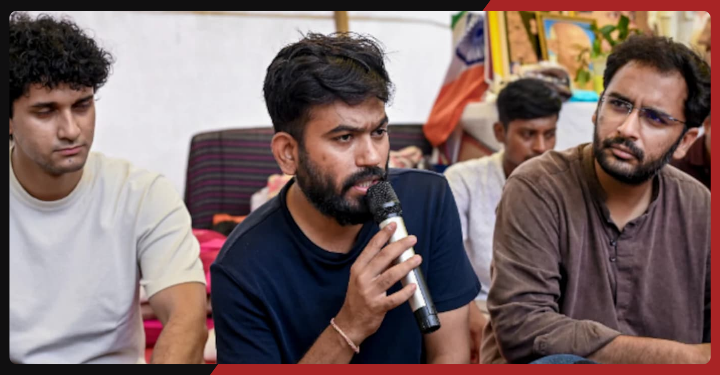
New Delhi, October 16, 2026: Abhijeet Dipke has escalated his public challenge to authorities by declaring that he is ready to face imprisonment rather than abandon the Cockroach Janta Party’s planned demonstrations in Delhi and Mumbai. His statement comes amid police restrictions, the detention of fellow CJP leaders and a continuing dispute over the revision of electoral rolls.
Thank you for reading this post, don't forget to subscribe!Dipke, the founder of the CJP, said he believed that police might detain him ahead of the organisation’s planned “Lehra Do Tiranga” protests. He alleged that he was being watched by security personnel and that vehicles without number plates had been following him. These claims were reported as allegations made by Dipke and were not independently established by the available reports.
Despite his concerns, Dipke said the campaign would continue. He emphasised the national flag as a symbol of the protest and insisted that participants intended to act peacefully. His remarks were aimed at reassuring supporters that the possibility of arrest would not force the organisation to withdraw its demands.
The CJP has called for gatherings at Central Park in Delhi’s Connaught Place and at Azad Maidan in Mumbai. The demonstrations are intended to express solidarity with Ashutosh Ranka and Saurav Das, two party leaders who were reportedly placed in five-day judicial custody after their detention following an earlier protest at Jantar Mantar.
The organisation is also demanding the resignation of Chief Election Commissioner Gyanesh Kumar over the Special Intensive Revision of electoral rolls. The CJP has raised concerns about the removal of voter names and the possibility that eligible citizens could lose access to the electoral process.
The Election Commission has defended the revision exercise, saying it is intended to improve the accuracy of electoral rolls by identifying duplicate and ineligible entries. The controversy centres on competing claims about the process, its consequences and the safeguards available to citizens who believe their registration details have been wrongly altered.
The planned demonstrations have created a fresh challenge for authorities in the national capital. Police have cited prohibitory orders under Section 163 of the Bharatiya Nagarik Suraksha Sanhita and the absence of the necessary permission for a large gathering at Central Park.
Authorities have maintained that the national flag itself is not the issue. Their stated concern is whether an organised gathering complies with the restrictions governing the location. Central Park was also scheduled to remain closed to the public on October 16 and 17.
The Delhi High Court declined to restrain the proposed demonstration and took note of the police’s assurance that the event would be regulated. Police indicated that a small group of 11 participants could be allowed to carry the national flag and sing the national anthem at a suitable location.
Mumbai police reportedly granted permission for the planned gathering at Azad Maidan. This means the two demonstrations are proceeding under different local arrangements, rather than under a single uniform set of conditions.
The confrontation has broader implications for the relationship between protest movements and public institutions. Authorities must maintain public order and enforce lawful restrictions, while peaceful demonstrators seek space to express political disagreement and demand accountability.
The CJP’s campaign has attracted attention partly because of its confrontational messaging and Dipke’s willingness to acknowledge the possibility of imprisonment. However, the lasting impact of the movement will depend on more than its public statements. It will also depend on whether it can sustain peaceful mobilisation, present evidence supporting its allegations and secure meaningful engagement with the relevant institutions.
For the Election Commission, public confidence depends on accurate records, transparent procedures and effective ways to correct mistakes. For protesters, credibility depends on clearly articulating their demands and observing the law while exercising their rights.
The immediate questions remain whether Dipke will be detained, how the proposed gatherings will proceed and whether authorities will respond to the organisation’s demands. The outcome of the protests is uncertain, and the CJP’s demand for Gyanesh Kumar’s resignation has not been accepted in the reports available at the time of writing.
Nevertheless, Dipke’s declaration has ensured that the planned demonstrations remain in the public spotlight. The continuing dispute underscores the importance of electoral transparency, peaceful political expression and accountability in a democratic system.


